Introduction
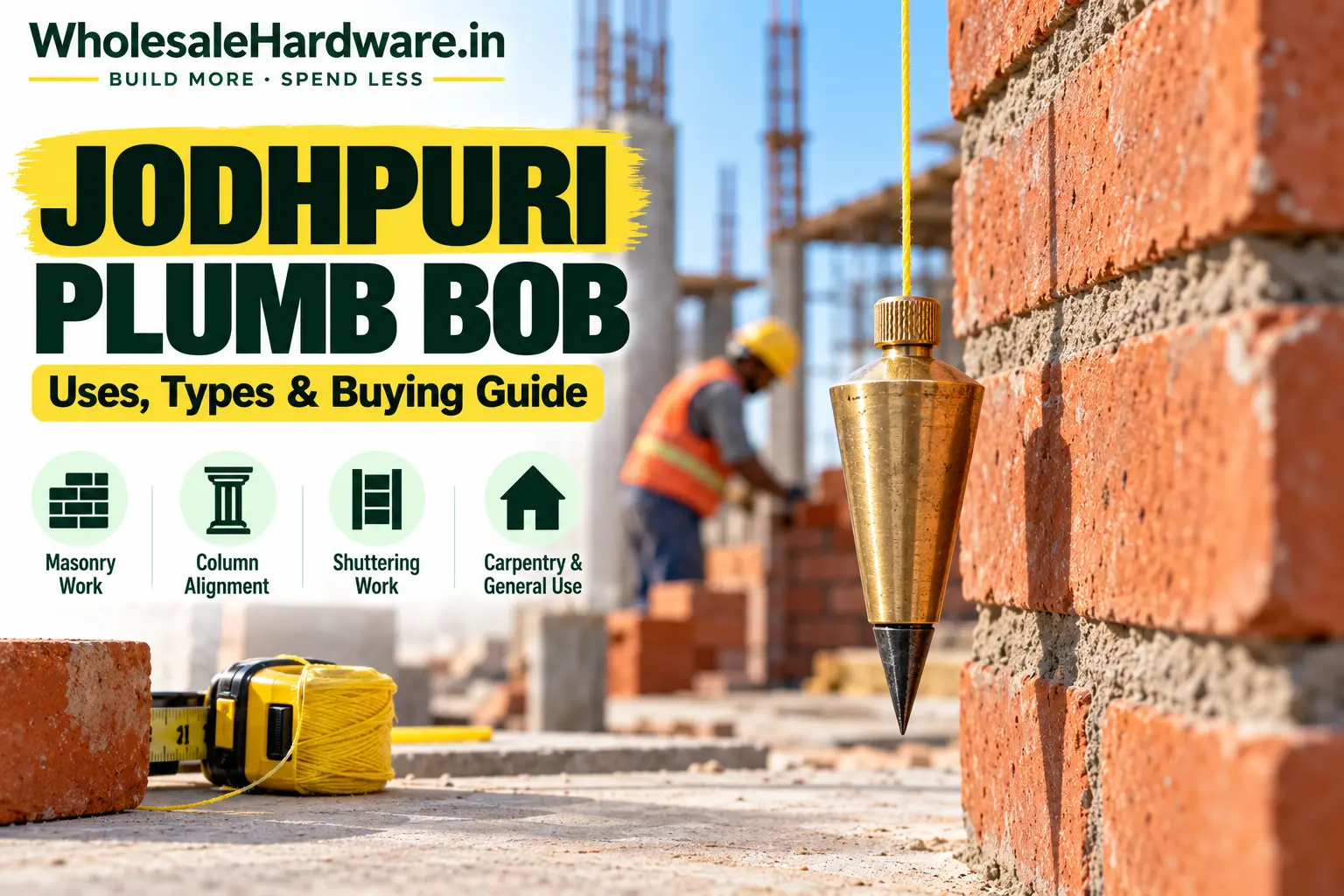
A Jodhpuri Plumb Bob is a simple mechanical tool used to establish and check a true vertical line. It is commonly used in construction, masonry, carpentry and other work where maintaining vertical alignment is important.
The tool consists of a weighted body suspended from a line. When you let the weight hang freely, gravity pulls it downward and establishes a vertical reference. This simple principle makes the plumb bob useful for checking walls, columns, frames and other vertical surfaces.
Jodhpuri-type plumb bobs are available in different sizes and designs. The right choice depends on the application, required handling characteristics and the specifications of the particular product.
In this guide, we’ll explain what a Jodhpuri Plumb Bob is, how it works, where workers use it, the available sizes, how to use it, and what to consider before buying one.
What Is a Jodhpuri Plumb Bob?
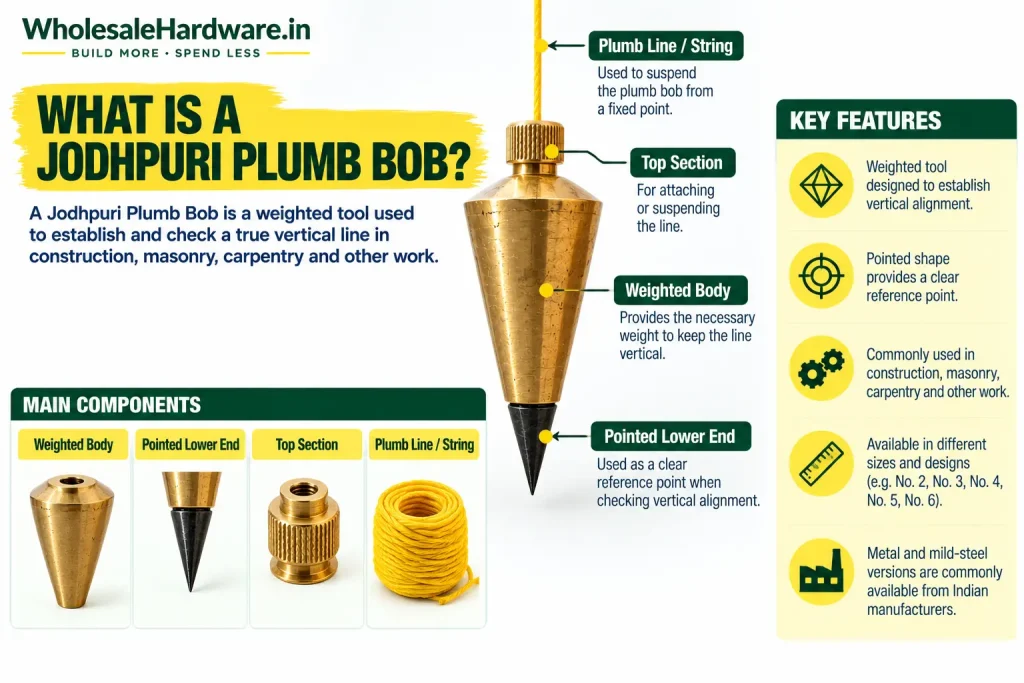
A Jodhpuri Plumb Bob is a weighted construction and measuring tool designed to establish vertical alignment.
The pointed shape of the body allows the user to use the tip as a clear reference point when checking a wall, column, frame or other structure.
Indian hardware manufacturers commonly list Jodhpuri-type plumb bobs as a specific type, with metal and mild-steel versions available in the market. Exact dimensions, weight and finish can vary between manufacturers.
The basic components are:
- A weighted plumb-bob body.
- A pointed lower end.
- A top section for attaching or suspending the line.
- A plumb line or string.
The product shown in the photograph has the characteristic conical body and pointed lower end associated with this type of tool.
How Does a Plumb Bob Work?
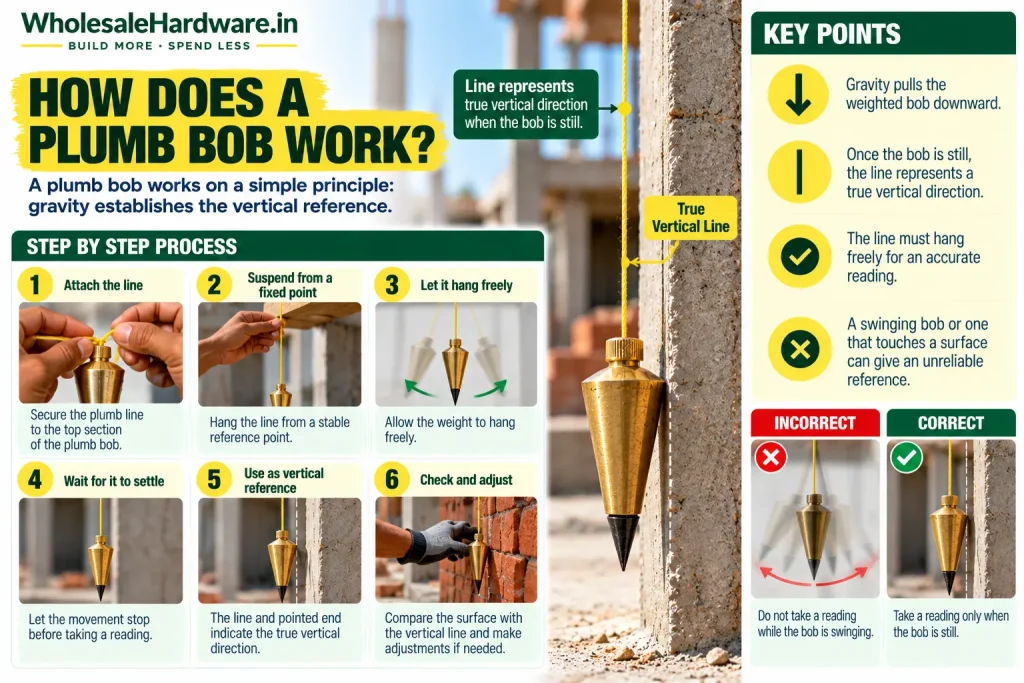
The working principle is simple: gravity establishes the vertical reference.
When you suspend the plumb bob from a fixed point, its weight pulls the line downward. Once the bob stops swinging, the line represents a true vertical direction.
The basic process is:
- Attach the line to the plumb bob.
- Suspend the line from the required reference point.
- Allow the weight to hang freely.
- Wait for the movement to settle.
- Use the line and pointed end as the vertical reference.
The line needs to hang freely for the reading to be useful. A swinging bob or one that touches a surface can provide an unreliable reference.
What Do Workers Use a Jodhpuri Plumb Bob For?
Workers primarily use a Jodhpuri plumb bob to establish or check verticality.
Common applications include:
- Brick masonry.
- Wall alignment.
- Column alignment.
- Column shuttering.
- Retaining wall shuttering.
- Door and window frame alignment.
- Carpentry.
- General construction work.
- Transferring vertical reference points.
- Checking vertical surfaces.
A construction demonstration specifically shows plumb-bob use for brick masonry, column shuttering, retaining wall shuttering and column centreline work.
Jodhpuri Plumb Bob for Brick Masonry
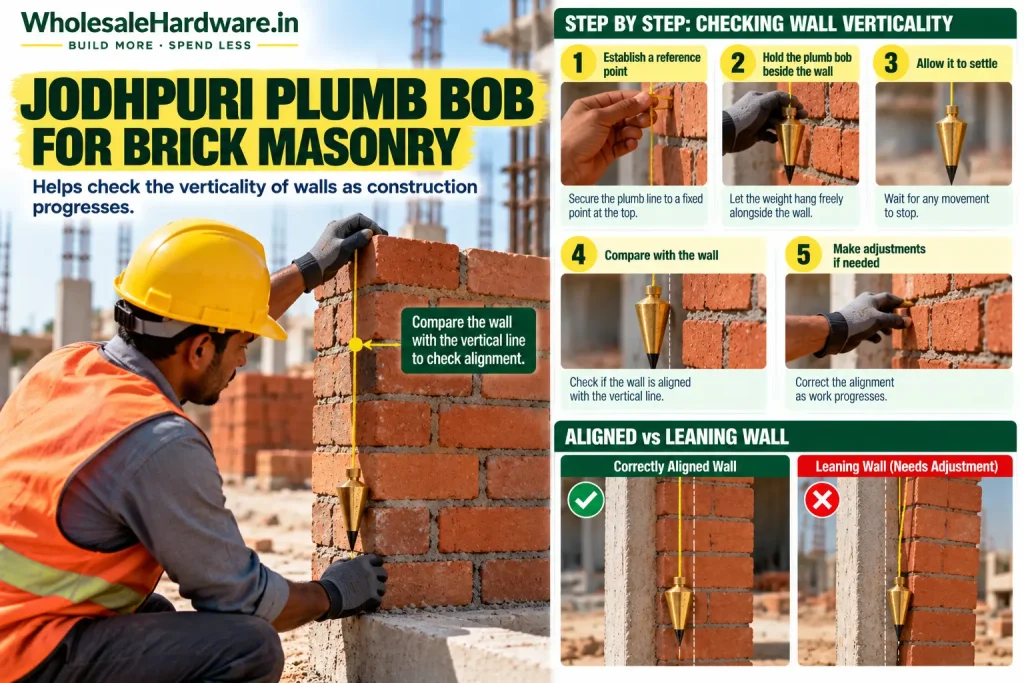
Brick masonry is one of the most practical applications for a plumb bob.
As masons build a wall upward, they must ensure that it does not gradually lean inward or outward. Workers can compare the plumb bob’s vertical reference against the face of the wall.
Construction guidance for masonry specifically recommends using a plumb bob to check the verticality of walls and columns as work progresses.
A typical workflow involves:
- Establishing the reference line.
- Holding the plumb bob beside the masonry.
- Allowing it to settle.
- Comparing the wall with the vertical line.
- Making adjustments where necessary.
This design makes the tool particularly useful for walls that require a longer vertical reference.
Jodhpuri Plumb Bob for Columns and Shuttering
Columns need to remain vertically aligned as construction progresses.
Workers can use a plumb bob alongside other measuring tools to check the alignment of column formwork and structural elements.
Practical construction training material demonstrates the use of a plumb bob for column shuttering and column centreline work.
It can also be useful when checking whether formwork is leaning away from the intended vertical position.
For more precise structural work, use appropriate surveying or measurement equipment according to the project requirements.
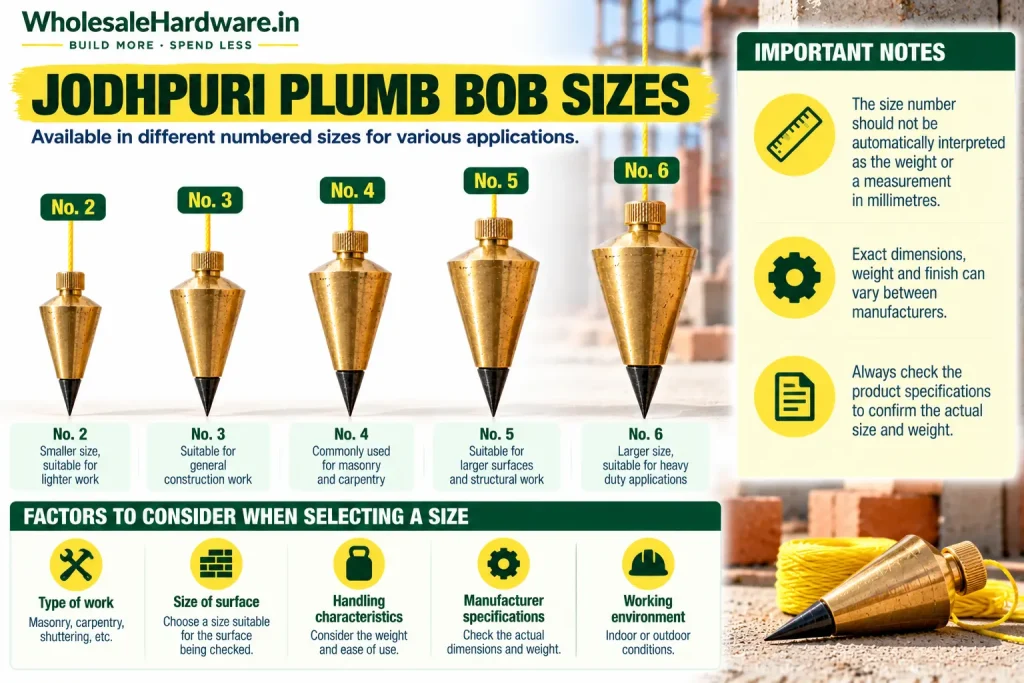
Jodhpuri Plumb Bob Sizes
Jodhpuri plumb bobs are available in different numbered sizes.
The sizes currently available in our range are:
| Available Size |
|---|
| No. 2 |
| No. 3 |
| No. 4 |
| No. 5 |
| No. 6 |
The size number should not automatically be interpreted as the weight or a measurement in millimetres. Because manufacturers may use different sizing systems, check the product specification to confirm the actual dimensions and weight.
When selecting a size, consider:
- The type of work.
- The required handling characteristics.
- The size of the surface being checked.
- The manufacturer’s specifications.
- The working environment.
If you are purchasing in bulk, confirming the exact size and product specification with the supplier can help avoid confusion between different manufacturers’ numbering systems.
What Materials Do Manufacturers Use to Make a Jodhpuri-Type Plumb Bob?
Jodhpuri-type plumb bobs are commonly available in metal constructions, including mild-steel versions. Current Indian manufacturer listings show conical mild-steel Jodhpuri-type products with different weights and finishes.
However, the exact material should not be assumed simply from the appearance of a product.
Depending on the manufacturer, specifications may differ in:
- Body material.
- Surface finish.
- Weight.
- Dimensions.
- Tip construction.
- Line attachment.
- Overall design.
For a specific product, the manufacturer’s specification should be treated as the correct reference.
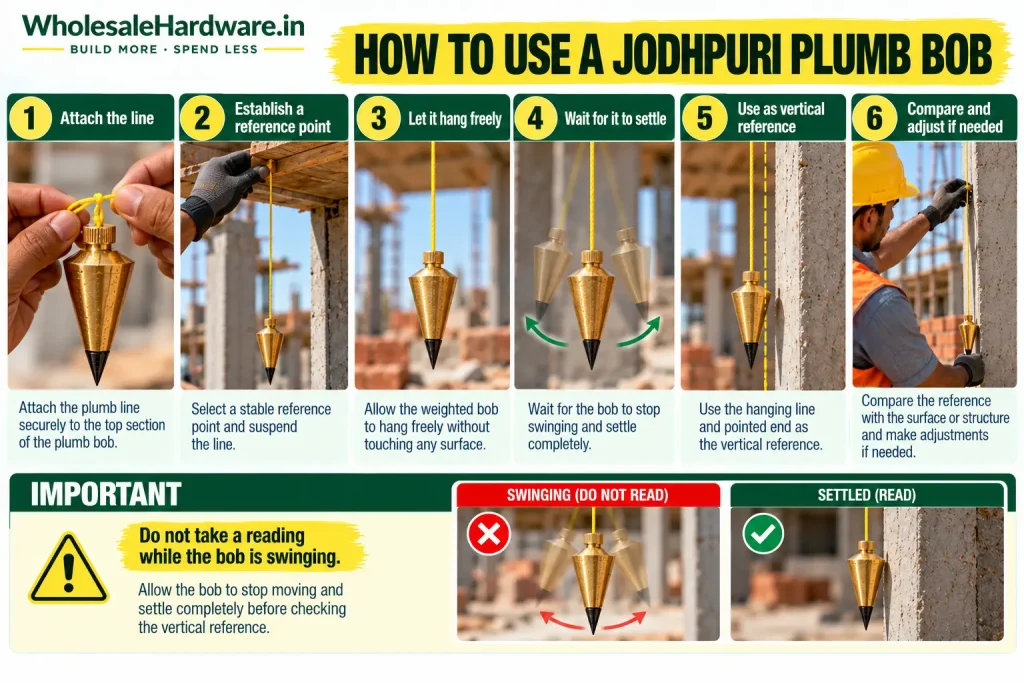
How to Use a Jodhpuri Plumb Bob
Using a plumb bob is straightforward, but getting a reliable reference requires the tool to be allowed to settle properly.
1. Attach the Line
Secure the plumb line to the attachment point at the top of the bob.
2. Establish the Reference Point
Position the upper end of the line at the point from which the vertical reference needs to be established.
3. Let the Bob Hang Freely
Allow the weighted body to move naturally instead of forcing it against the surface.
4. Wait for It to Settle
The bob may swing when first released. Allow the movement to reduce before taking the reading.
5. Check the Vertical Reference
Compare the line or pointed end with the wall, column, frame or other element being checked.
6. Make the Required Adjustment
If the construction element does not align with the reference, adjust it as needed and check it again.
A freely hanging bob is important because the tool establishes its vertical reference through gravity.
Jodhpuri Plumb Bob vs Spirit Level
Workers can use a plumb bob and a spirit level to check alignment, but each tool works differently.
| Jodhpuri Plumb Bob | Spirit Level |
|---|---|
| Uses gravity and a suspended weight | Uses a bubble vial |
| Establishes a vertical reference | Can check horizontal and vertical surfaces |
| Useful for longer vertical references | Convenient for shorter surfaces |
| Simple mechanical tool | Compact measuring tool |
| Common in masonry and construction | Common in construction, carpentry and installation |
Construction training material notes that a spirit level can be convenient for smaller vertical surfaces, while a plumb bob can be more appropriate for larger surfaces.
This means the two tools don’t necessarily compete with each other. Workers can use them together depending on the job.
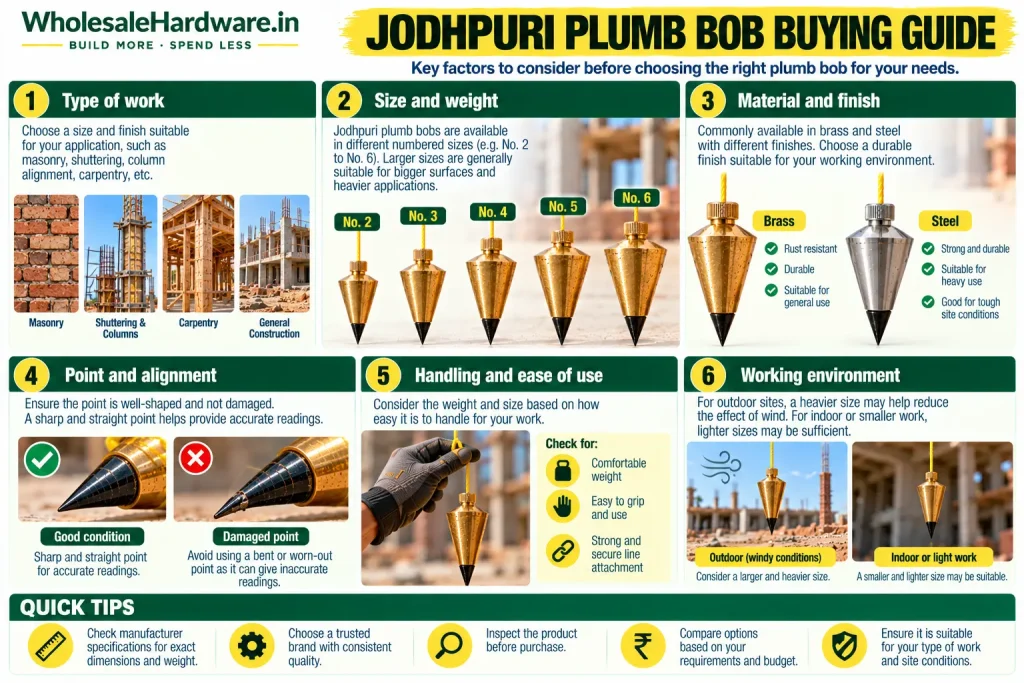
What Makes a Good Jodhpuri Plumb Bob?
When buying a plumb bob, look beyond the colour or basic appearance.
Properly Formed Point
The pointed end should be properly formed and aligned because it serves as an important reference point.
Suitable Weight
The weight should be appropriate for the intended application and should settle properly after being suspended.
Good Construction
The body should be properly formed, with the attachment point securely integrated into the product.
Suitable Finish
A suitable finish can help protect the body and provide a cleaner working surface.
Secure Line Attachment
The connection between the plumb bob and line should be suitable for the intended use.
Consistent Manufacturing
For bulk purchases, consistency in size, weight and finish can be particularly important.
How to Choose the Right Jodhpuri Plumb Bob
There isn’t one size that is best for every application.
Consider these factors before purchasing:
Application
Determine whether the tool will primarily be used for masonry, columns, shuttering, carpentry or general alignment work.
Size
Choose an appropriate size based on the work and the manufacturer’s specifications.
Weight
A suitable weight should provide a stable hanging reference without making the tool unnecessarily difficult to handle.
Construction
Check the body material, shape, finish and attachment point.
Frequency of Use
For regular professional work, consistent construction and durability may be more important than simply choosing the lowest-priced option.
Common Mistakes When Using a Plumb Bob
A simple tool can still give poor results if it isn’t used correctly.
Avoid these common mistakes:
- Taking a reading while the bob is still swinging.
- Holding the line against the wall.
- Allowing the line to become tangled.
- Using a damaged or bent point.
- Ignoring strong wind or air movement.
- Comparing the bob against an uneven reference incorrectly.
- Assuming that every numbered size has the same specifications across manufacturers.
- Using a general-purpose plumb bob for an application that requires specialised surveying equipment.
A damaged point is particularly important to watch for. A bent or misaligned point can affect how accurately the tool can be used as a reference.
Jodhpuri Plumb Bob for Different Applications
The same basic principle can be useful across several trades.
Masonry
Used to check the verticality of walls as brickwork progresses.
Construction
Useful for checking vertical alignment of structural and temporary construction elements.
Shuttering
Can help check the vertical position of column and wall formwork.
Carpentry
Can be used for checking the vertical alignment of frames and other elements.
General Maintenance
Useful wherever a simple vertical reference is required.
How to Store a Plumb Bob
A few simple practices can help keep the tool in usable condition.
- Store it in a dry place.
- Keep the point protected from impact.
- Avoid dropping the bob.
- Keep the line clean and untangled.
- Check the attachment point periodically.
- Inspect the pointed end before important work.
- Avoid storing it where other heavy tools can strike it.
The pointed end is especially worth protecting because damage to it can affect practical use.
Jodhpuri Plumb Bob vs Other Alignment Tools
A plumb bob is one of several tools that can help with construction alignment.
| Tool | Main Purpose |
|---|---|
| Jodhpuri Plumb Bob | Checking vertical alignment |
| Spirit Level | Checking horizontal and vertical levels |
| Straight Edge | Checking straightness and surface alignment |
| Mason’s Line | Maintaining course alignment in masonry |
| Measuring Tape | Measuring distance and dimensions |
These tools often work best together rather than as substitutes for one another.
For example, masonry guidance recommends using a straight edge and spirit level to check course alignment and a plumb bob to check verticality
Why Is a Plumb Bob Still Used Today?
A plumb bob is one of the simplest construction tools, but its operating principle remains useful.
It doesn’t require:
- Batteries.
- Electronics.
- A digital display.
- Complex setup.
Instead, it uses gravity to establish the vertical reference.
That simplicity is one reason plumb bobs continue to appear in construction and masonry work. Current construction training resources still demonstrate their use for walls, columns and shuttering.
For more demanding surveying or precision applications, specialised instruments may be more appropriate.
Frequently Asked Questions
What is a Jodhpuri Plumb Bob?
Workers use a Jodhpuri plumb bob with a suspended line to establish and check vertical alignment. Construction workers, masons, carpenters, and other professionals commonly use it for related work.
What is a Jodhpuri Plumb Bob used for?
It is mainly used to check the verticality of walls, columns, shuttering, frames and other structures.
How does a Jodhpuri Plumb Bob work?
The weighted body hangs from a line, and gravity pulls it downward. Once the bob settles, the line establishes a vertical reference.
What sizes of Jodhpuri Plumb Bob are available?
Our current range includes No. 2, No. 3, No. 4, No. 5 and No. 6.
Check the product specification to confirm the exact dimensions and weight for each numbered size.
Is a Jodhpuri Plumb Bob used in brick masonry?
Yes. Plumb bobs are commonly used to check the verticality of brick walls during masonry work.
Can a plumb bob be used for column alignment?
Yes. Construction demonstrations show plumb-bob use for checking column shuttering and column alignment.
What is the difference between a plumb bob and a spirit level?
A plumb bob uses a suspended weight and gravity to establish a vertical reference. A spirit level uses a bubble vial to check level or plumb.
What is the pointed end of a plumb bob for?
The pointed end provides a precise reference point when the tool is suspended and used for alignment or marking.
How long should I wait before taking a reading?
Wait until the bob has settled and is no longer swinging significantly. Wind and movement can increase the time required.
Is a heavier plumb bob always better?
Not necessarily. The appropriate weight depends on the application, working conditions and product specifications.
Can a Jodhpuri Plumb Bob replace a spirit level?
Not in every situation. The two tools work differently and can complement each other depending on the job.
🛒 Looking for a Jodhpuri Plumb Bob?
Looking for a Jodhpuri Plumb Bob for masonry, construction, shuttering, carpentry or general alignment work?
Our range includes No. 2, No. 3, No. 4, No. 5 and No. 6 sizes, giving you options for different construction and measurement requirements.
For bulk requirements, contact us with your required size, quantity and delivery location.
📚 You May Also Like
If you’re exploring construction and hardware products, you may also find these guides useful:
- Hammer Buying Guide – Understand different hammer types and their uses.
- Cutting Wheel Buying Guide – Learn about cutting wheel types, sizes and applications.
- Binding Wire Buying Guide – Understand binding wire and its common construction applications.
- PP Rope Buying Guide – Understand PP rope types, sizes, uses and selection factors.
- Plastic Ghamela & Gampa Buying Guide – Learn about sizes, uses and material-handling applications. (Coming Soon!)
- Hacksaw Blade Buying Guide – Learn how to choose the right hacksaw blade for different materials and applications. (Coming Soon!)
- Different Types of Fasteners and Their Uses – Learn about common fasteners used in construction and other applications. (Coming Soon!)
🔧 Explore More Hardware Categories
Explore more hardware products for construction, workshops, fabrication, maintenance and general utility requirements.
- Construction Hardware
- Hand Tools
- Measuring Tools
- Masonry Tools
- Cutting & Grinding
- Fasteners
- Ropes & Utility Products
- Safety Equipment
- Plumbing Hardware
- Power Tools
📞 Need Help Choosing the Right Jodhpuri Plumb Bob?
Not sure which Jodhpuri Plumb Bob is best for your construction, masonry, shuttering, carpentry, or general alignment work?
Choosing the right size and type can make vertical alignment work easier, especially when the tool is used regularly on construction sites.
Our team can help you select the right hardware products for fabrication workshops, construction sites, industrial projects, maintenance work, and bulk wholesale requirements.
📞 Contact Our Experts
📱 Call / WhatsApp: +91 99518 36524
🌐 Website: https://wholesalehardware.in
📩 Contact Us: https://wholesalehardware.in/contact-us/
📢 WhatsApp Channel: https://whatsapp.com/channel/0029Vb7kFcPGzzKK5wfKhf0Q
📘 Facebook: https://www.facebook.com/wholesalehardware.in/
📷 Instagram: https://www.instagram.com/wholesalehardware.in/
⭐ Why Choose WholesaleHardware.in?
WholesaleHardware.in provides hardware products and practical buying information for contractors, builders, fabricators, workshops, businesses, hardware dealers and general users.
Our buying guides are designed to make product selection easier by explaining applications, specifications and important factors to consider before purchasing.