Introduction
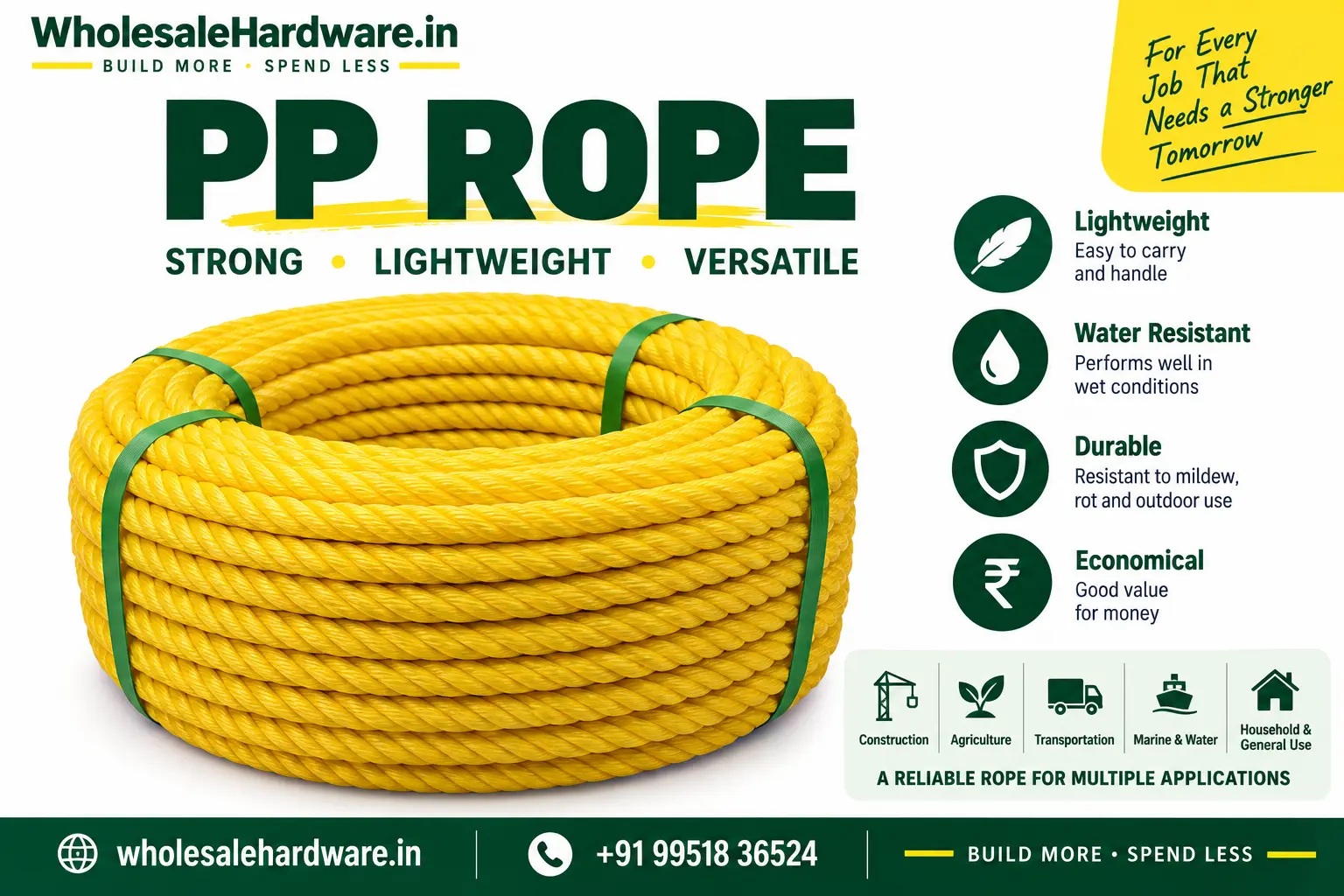
PP rope, short for polypropylene rope, is a lightweight synthetic rope used for a wide range of construction, agriculture, industrial, transportation, household and general-purpose applications. Its low weight, resistance to moisture and ability to float on water make it a practical choice for many situations where an easy-to-handle synthetic rope is required.
PP rope is available in different diameters, constructions and forms. The right rope depends on the application, required strength, rope construction, working environment and size.
In this guide, we’ll look at PP rope types, sizes, uses, advantages, limitations and the important factors to consider before buying one.
What Is PP Rope?
Polypropylene rope is a synthetic rope made from polypropylene, a thermoplastic polymer.
The polypropylene material is processed into fibres or filaments, which are then twisted or braided to form rope. Different manufacturing methods and rope constructions can produce products with different characteristics and applications.
Polypropylene rope is popular because it combines:
- Low weight.
- Good moisture resistance.
- Resistance to mildew and rot.
- Chemical resistance in many applications.
- Buoyancy in water.
- Easy handling.
- Relatively economical pricing.
The exact performance depends on the polypropylene material, rope construction, diameter, manufacturing quality and intended application.
PP Rope Sizes Available
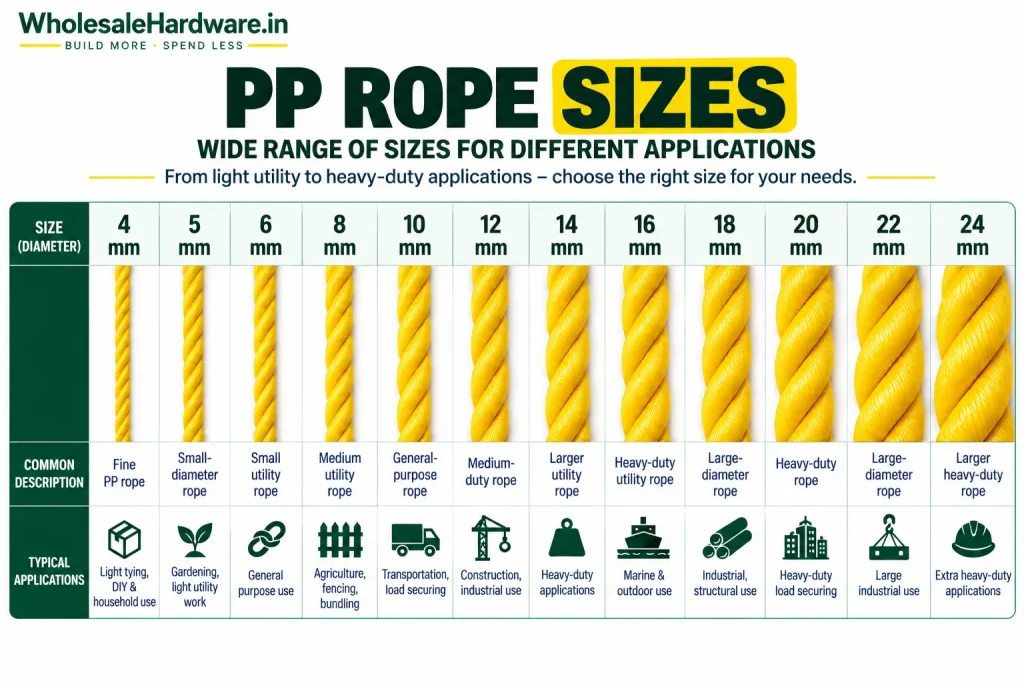
The PP rope range shown in the product photo currently includes the following diameters:
| Size | Common Description |
|---|---|
| 4 mm | Fine PP rope |
| 5 mm | Small-diameter PP rope |
| 6 mm | Small utility rope |
| 8 mm | Medium utility rope |
| 10 mm | General-purpose rope |
| 12 mm | Medium-duty rope |
| 14 mm | Larger utility rope |
| 16 mm | Heavy-duty utility rope |
| 18 mm | Large-diameter rope |
| 20 mm | Heavy-duty rope |
| 22 mm | Large-diameter rope |
| 24 mm | Larger heavy-duty rope |
These are the sizes currently shown in your product range.
Rope diameter alone, however, should not be used to determine safe working load. Breaking strength and working load depend on rope construction, material grade, manufacturing specifications, condition, knots and the application. Indian Standard material for polypropylene ropes specifically includes requirements relating to linear density and minimum breaking force.
How to Choose the Right PP Rope Size
The correct PP rope size depends mainly on what you are using it for.
A small-diameter rope may be suitable for light utility work, tying and general handling, while larger diameters can be selected for applications requiring greater strength or handling characteristics.
Consider these factors before choosing a size:
- Type of application.
- Expected load.
- Required rope length.
- Rope construction.
- Frequency of use.
- Environmental conditions.
- Manufacturer’s specifications.
A thicker rope is not automatically the right choice for every job. The construction and rated performance of the rope are equally important.
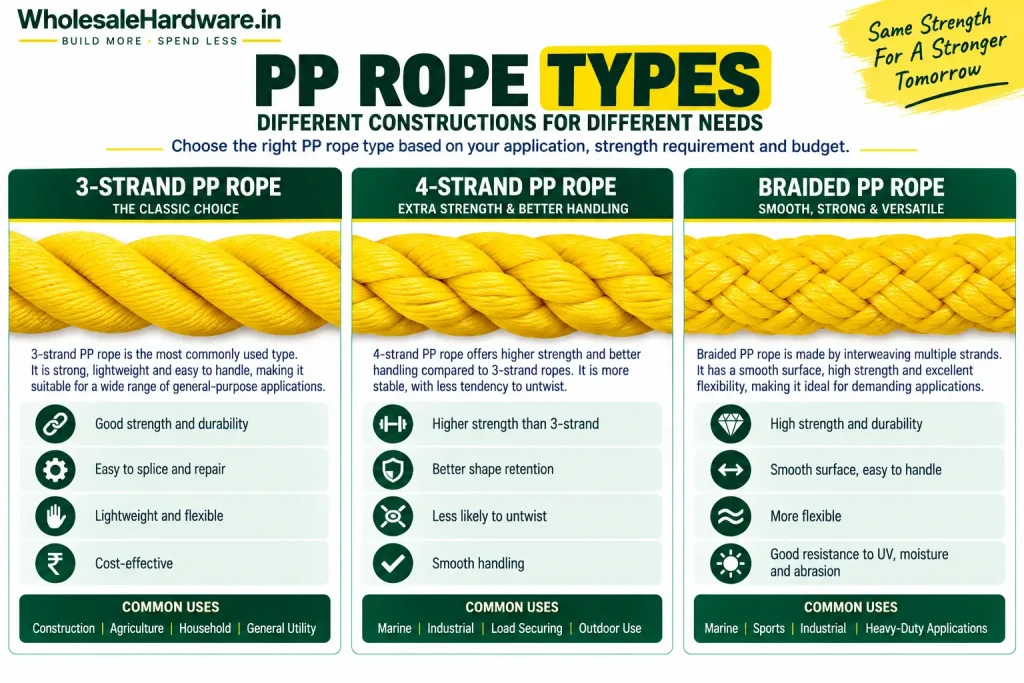
PP Rope Types
Polypropylene ropes are available in different constructions.
The current Indian standard IS 5175:2022 covers 3-, 4-, 8- and 12-strand polypropylene ropes.
3-Strand PP Rope
A 3-strand rope is made by twisting three strands together.
The product shown in your photograph appears to be a 3-strand twisted PP rope, based on its visible construction.
3-strand ropes are widely used because they are straightforward to handle, splice and inspect. Current polypropylene rope manufacturers offer 3-strand twisted constructions for applications ranging from general utility work to agriculture, construction and marine uses.
4-Strand PP Rope
A 4-strand construction uses four strands laid together.
It is one of the constructions covered by IS 5175:2022.
The exact performance and suitability depend on the rope’s material grade, construction and manufacturer’s specifications.
Braided PP Rope
Braided polypropylene ropes are constructed by interlacing strands rather than simply laying them together.
The Indian standard covers both 8-strand and 12-strand braided polypropylene ropes.
Braided construction can be useful when a particular combination of flexibility, handling and rope performance is required.
Why Is PP Rope Popular?
Polypropylene rope has several characteristics that make it useful across different industries.
Lightweight
Polypropylene is a relatively low-density material, making polypropylene rope easy to handle compared with many heavier rope materials.
Floats on Water
Polypropylene has a density lower than water, so PP rope can float.
This makes it useful for certain marine, water-based and floating-line applications.
Low Water Absorption
PP rope does not readily absorb water, which can be useful in wet environments.
Resistance to Mildew and Rot
Polypropylene synthetic rope is not subject to the biological deterioration associated with many natural-fibre ropes. Manufacturers commonly highlight its resistance to mildew and rot.
Chemical Resistance
Polypropylene has useful resistance to many chemicals, although the suitability of a rope depends on the specific chemical, concentration, temperature and exposure conditions.
Easy to Handle
The combination of low weight and flexibility makes PP rope convenient for many general-purpose applications.
PP Rope Uses
The versatility of polypropylene rope makes it useful in many different areas.
Construction
Polypropylene rope can be used for various general construction and site-handling tasks, including:
- Temporary tying.
- Securing materials.
- General material handling.
- Bundling.
- Supporting or positioning materials where appropriate.
- General-purpose site work.
The rope should only be used for lifting, fall protection or other safety-critical applications when it is specifically rated and approved for that purpose.
Agriculture
Polypropylene rope is commonly used in agricultural environments.
Typical applications include:
- Tying and bundling.
- Supporting plants and structures.
- General farm work.
- Securing materials.
- Hay and agricultural material handling.
- Temporary arrangements around farms.
Its lightweight nature and moisture resistance can be useful for outdoor applications.
Transportation
Polypropylene rope can be useful for general tying and securing applications in transportation.
It may be used for:
- Bundling materials.
- Securing loads where appropriate.
- General tying.
- Packaging-related applications.
For vehicle load restraint, always use equipment specifically rated for the load and application rather than assuming that any PP rope is suitable.
Industrial Applications
PP rope is used across various industrial environments for general-purpose handling, tying, bundling and securing.
Industrial applications can require specific rope specifications, so check the manufacturer’s technical information when strength or long-term performance is important.
Marine and Water Applications
One of the distinctive characteristics of polypropylene rope is its buoyancy.
Because polypropylene rope floats, it is used for certain:
- Floating lines.
- Buoy lines.
- Pool applications.
- General marine work.
- Water-safety applications.
Specialised marine applications require the correct rope construction and specifications rather than simply choosing any polypropylene rope.
Household and General Utility Work
Smaller PP ropes can also be useful for everyday applications such as:
- Tying.
- Bundling.
- Temporary supports.
- General storage.
- Outdoor utility work.
- Garden work.
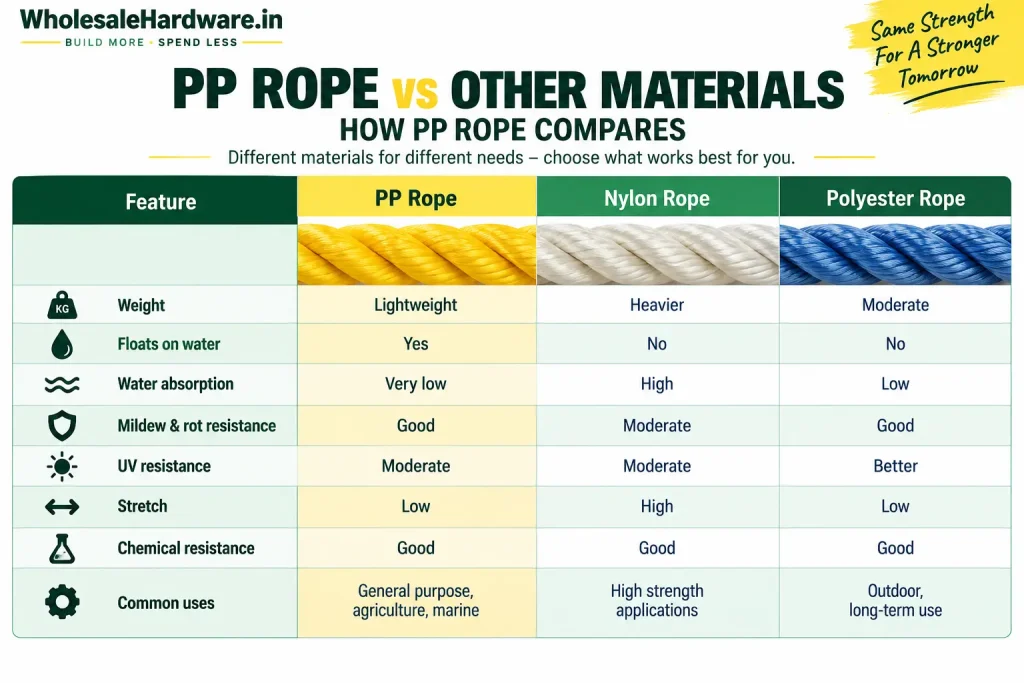
PP Rope vs Other Common Rope Materials
Different rope materials have different properties.
| Feature | PP Rope | Nylon Rope | Polyester Rope |
|---|---|---|---|
| Weight | Lightweight | Generally heavier | Generally heavier |
| Water behaviour | Floats | Generally sinks | Generally sinks |
| Moisture resistance | Good | Absorbs more moisture | Very good |
| UV performance | Depends on formulation/stabilisation | Moderate | Generally good |
| Stretch | Application-dependent | Higher stretch | Lower stretch |
| Chemical resistance | Good against many chemicals | Depends on chemical | Generally good |
| Common applications | Utility, agriculture, construction, marine | Lifting, marine, general industrial | Marine, industrial, outdoor |
This comparison is a general guide. Specific rope performance depends on the construction and manufacturer’s specifications.
How Strong Is PP Rope?
There is no single strength value for PP rope.
Breaking strength varies according to:
- Diameter.
- Rope construction.
- Fibre type.
- Material grade.
- Manufacturing quality.
- Rope condition.
- Splicing or termination.
- Knots and bends.
The current Indian standard includes minimum breaking-force requirements for specified polypropylene rope constructions and sizes.
Important:
Breaking strength is not the same as safe working load.
A rope should not simply be loaded up to its breaking strength. Working-load limits must be established according to the rope manufacturer’s instructions and the actual application.
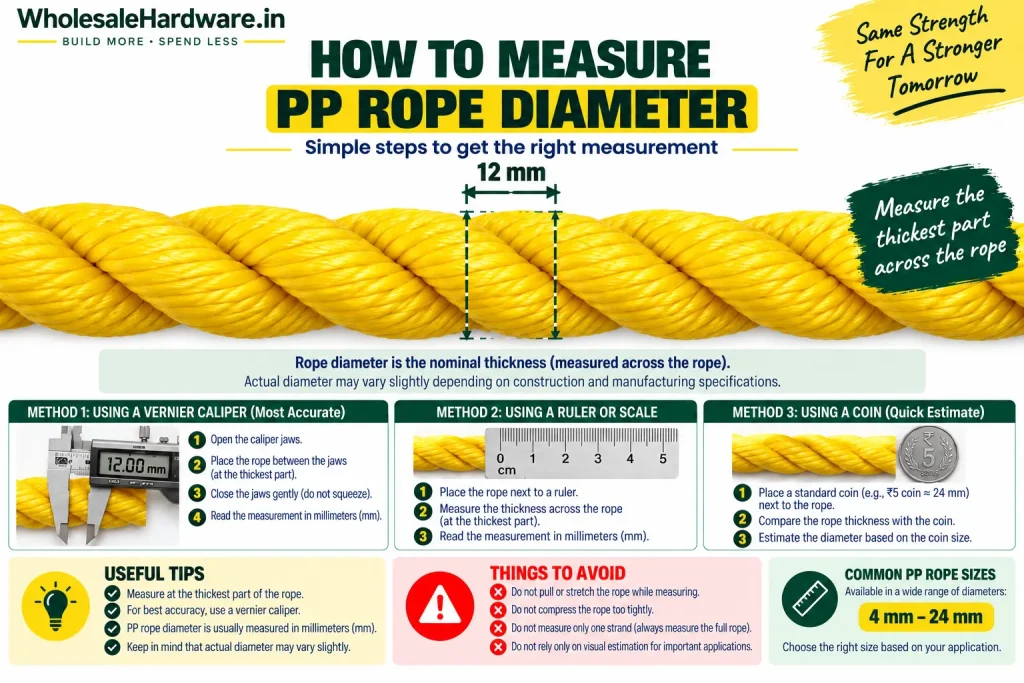
What Does Rope Diameter Mean?
When a polypropylene rope is described as 10 mm, 12 mm, 16 mm or 24 mm, the number generally refers to the rope’s nominal diameter.
For example:
12 mm PP rope = nominal 12 mm rope diameter
However, actual measured diameter can vary within manufacturing tolerances and according to the rope’s construction and condition.
For commercial or industrial requirements, always refer to the manufacturer’s stated specifications rather than relying only on visual measurement.
How to Select the Right PP Rope
Before purchasing polypropylene rope, consider these factors.
1. Identify the Application
First decide what you actually need the rope to do.
A rope used for general tying does not necessarily require the same specifications as one used for a demanding industrial application.
2. Choose the Diameter
Select the diameter according to the required performance and handling requirements.
The available range shown in your current stock photo runs from 4 mm to 24 mm.
3. Check the Rope Construction
Determine whether you need a 3-strand, 4-strand or braided construction.
4. Consider the Environment
Think about exposure to:
- Water.
- Sunlight.
- Chemicals.
- Abrasion.
- Dirt.
- Repeated handling.
5. Check the Manufacturer’s Specifications
For important applications, look for information such as:
- Rope construction.
- Material type.
- Diameter.
- Linear density.
- Breaking strength.
- Length.
- Working-load information, where applicable.
PP Rope for Construction: Which Size Should You Choose?
There is no universal size that is “best” for every construction application.
As a general product-selection approach:
| Requirement | Possible Starting Range |
|---|---|
| Light tying and utility work | 4–8 mm |
| General tying and bundling | 8–12 mm |
| Medium-duty general use | 12–16 mm |
| Larger/heavier utility applications | 16–24 mm |
These are not load ratings.
They are simply a practical way to organise the available sizes. The correct rope should be selected according to the actual application and manufacturer specifications.
How to Store PP Rope
Proper storage can help maintain rope condition.
- Keep the rope clean and dry when practical.
- Avoid unnecessary exposure to extreme heat.
- Store it away from sharp edges.
- Avoid prolonged exposure to damaging chemicals.
- Keep it organised rather than leaving it under heavy loads.
- Inspect the rope before using it for demanding applications.
UV exposure can affect synthetic ropes over time, and performance depends on the rope’s formulation and stabilisation. Some PP ropes are specifically UV-stabilised, so check the manufacturer’s specification when outdoor service is important.
Common PP Rope Buying Mistakes
Avoid these mistakes when purchasing polypropylene rope:
- Choosing a rope based only on diameter.
- Assuming every polypropylene rope has the same strength.
- Treating breaking strength as a working load.
- Ignoring rope construction.
- Using general-purpose rope for a safety-critical application.
- Buying a rope without checking the required length.
- Assuming all polypropylene rope has the same UV resistance.
- Selecting a rope solely because it is inexpensive.
The right rope is the one that matches the application, construction, diameter and required performance.
PP Rope Standards in India
For buyers who need specification-based products, IS 5175:2022 is an important Indian Standard for polypropylene fibre ropes.
The standard covers polypropylene split-film, monofilament, multifilament and high-tenacity multifilament ropes in 3-, 4-, 8- and 12-strand constructions. It also addresses characteristics such as linear density and minimum breaking force.
The standard aligns with ISO 1346:2021.
For a product that needs to comply with a particular standard or certification requirement, buyers should verify the manufacturer’s documentation and current applicable requirements rather than assuming that every polypropylene rope automatically conforms.
Useful standards references:
Frequently Asked Questions
What is PP rope?
Manufacturers make PP rope from polypropylene, a synthetic material. It is lightweight, moisture-resistant and buoyant, making it useful for construction, agriculture, industrial, marine and general utility applications.
What does PP stand for in rope?
PP stands for polypropylene.
Does PP rope float?
Yes. Polypropylene is less dense than water, so polypropylene rope generally floats.
Is PP rope waterproof?
PP rope has very low water absorption and performs well in wet conditions. However, “waterproof” should not be interpreted as meaning that every polypropylene rope is suitable for every underwater or marine application.
What sizes of PP rope are available?
The polypropylene rope range currently shown by us includes 4 mm, 5 mm, 6 mm, 8 mm, 10 mm, 12 mm, 14 mm, 16 mm, 18 mm, 20 mm, 22 mm and 24 mm.
Which PP rope size is best for construction?
There is no single best size. The appropriate diameter depends on whether the rope is being used for tying, bundling, material handling or another application. Check the manufacturer’s specifications to determine the required strength.
Is thicker PP rope always stronger?
Not necessarily. Diameter is an important factor, but rope construction, material grade and manufacturing quality also affect performance.
Is PP rope good for outdoor use?
PP rope can be suitable for many outdoor applications, particularly where low weight and moisture resistance are useful. For prolonged outdoor exposure, check whether the specific rope is UV-stabilised.
Is PP rope suitable for lifting?
Do not assume that general-purpose polypropylene rope is suitable for lifting. Lifting applications require rope and equipment specifically rated for lifting, with appropriate working-load information and safety procedures.
What is the difference between PP rope and nylon rope?
PP rope is lighter and floats on water, while nylon generally has higher stretch and different strength and moisture characteristics. The best material depends on the application.
What is the difference between PP rope and polyester rope?
PP rope is lighter and floats, while polyester generally offers better resistance to UV exposure and lower stretch. The right choice depends on the environment and application.
What is a 3-strand PP rope?
A 3-strand polypropylene rope is made by twisting three strands together. It is a common rope construction and is covered by IS 5175:2022 for polypropylene fibre ropes.
🛒 Looking for PP Rope?
Looking for PP rope for construction, agriculture, industrial, transportation, marine or general utility applications?
We currently offer polypropylene rope in sizes ranging from 4 mm to 24 mm, subject to availability.
Whether you need rope for tying, bundling, general material handling or other applications, choosing the right diameter and construction can help you get better performance from the product.
👉 Shop PP Rope:
https://wholesalehardware.in/shop/polyproplene-rope/
For bulk requirements, contact us with your required size, quantity and delivery location.
📚 You May Also Like
If you’re exploring construction and hardware products, you may also find these guides useful:
- Hammer Buying Guide – Understand different hammer types and their applications.
- Cutting Wheel Buying Guide – Learn about cutting wheel types, sizes, materials and uses.
- Binding Wire Buying Guide – Understand binding wire and its applications in construction.
- Different Types of Fasteners and Their Uses – Learn about common fasteners used across construction and other industries. (Coming Soon)
- Plastic Ghamela & Gampa Buying Guide – Learn about ghamela sizes, applications and selection. (Coming Soon)
- Hacksaw Blade Buying Guide – Learn how to choose hacksaw blades based on TPI, material, size and application. (Coming Soon)
🔧 Explore More Hardware Categories
Explore more hardware products for construction, workshops, fabrication, maintenance and general utility requirements.
- Construction Hardware
- Hand Tools
- Cutting & Grinding
- Fasteners
- Ropes
- Safety Equipment
- Plumbing Hardware
- Power Tools
📞 Need Help Choosing the Right PP Rope?
Not sure which PP rope size or type is best for your application?
Whether you need PP rope for construction, agriculture, material handling, transportation, industrial work or general utility use, choosing the right diameter and construction can make a difference in handling and performance.
Our team can help you select the right hardware products for fabrication workshops, construction sites, industrial projects, maintenance work, and bulk wholesale requirements.
📞 Contact Our Experts
📱 Call / WhatsApp: +91 99518 36524
🌐 Website: https://wholesalehardware.in
📩 Contact Us: https://wholesalehardware.in/contact-us/
📢 WhatsApp Channel: https://whatsapp.com/channel/0029Vb7kFcPGzzKK5wfKhf0Q
📘 Facebook: https://www.facebook.com/wholesalehardware.in/
📷 Instagram: https://www.instagram.com/wholesalehardware.in/
⭐ Why Choose WholesaleHardware.in?
WholesaleHardware.in provides hardware products and practical buying information for contractors, builders, fabricators, workshops, businesses, hardware dealers and general users.
Our buying guides make product selection easier by explaining applications, specifications, and important factors to consider before purchasing.