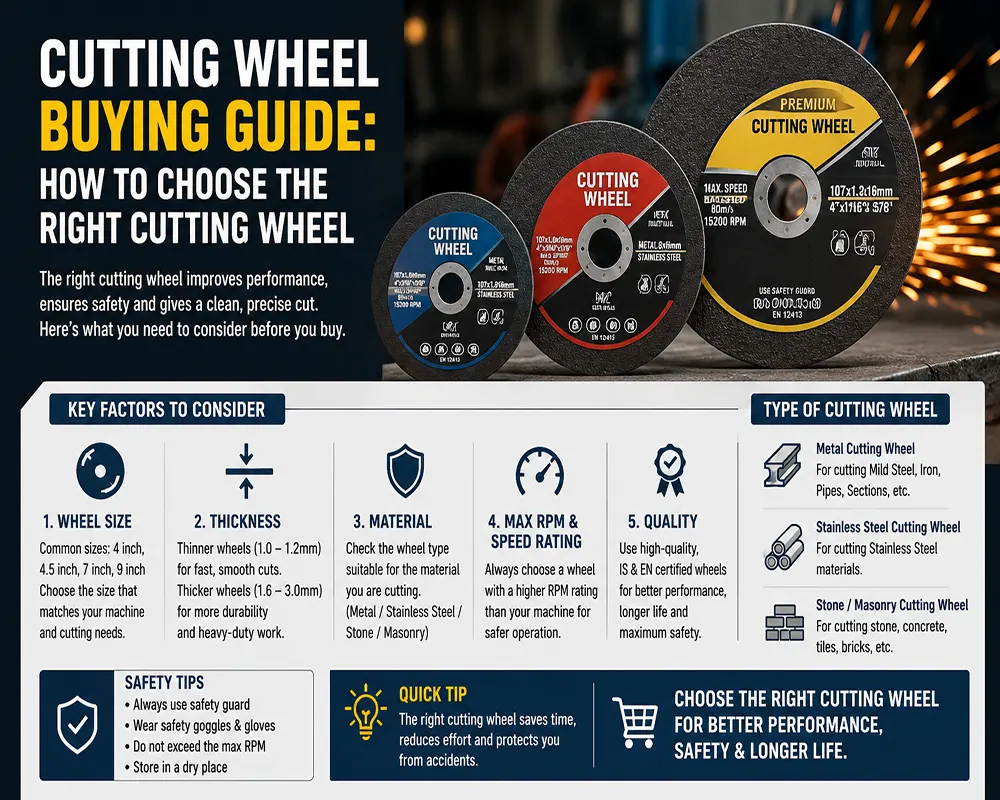
Introduction
Choosing the right cutting wheel can make a significant difference in the quality of your work, the life of your tools, and your overall safety. This Cutting Wheel Buying Guide will help you choose the right cutting wheel for metal, stainless steel, concrete, tiles, and masonry applications. Whether you’re a contractor, fabricator, workshop owner, or DIY enthusiast, this guide explains everything you need to know before buying a cutting wheel.
This Cutting Wheel Buying Guide explains the different types of cutting wheels, common sizes, applications, and the key factors to consider before buying one. By the end of this guide, you’ll know exactly which cutting wheel is best for your project.
Cutting Wheel Buying Guide: What is a Cutting Wheel?
A cutting wheel is a thin abrasive disc designed to cut materials such as metal, stainless steel, concrete, stone, tiles, and masonry using power tools like angle grinders and cut-off machines. Different cutting wheels are manufactured for specific materials, so using the correct wheel improves cutting speed, accuracy, and safety.
Choosing the right cutting wheel also helps reduce material wastage, extends the life of the wheel, and delivers cleaner, more precise cuts.
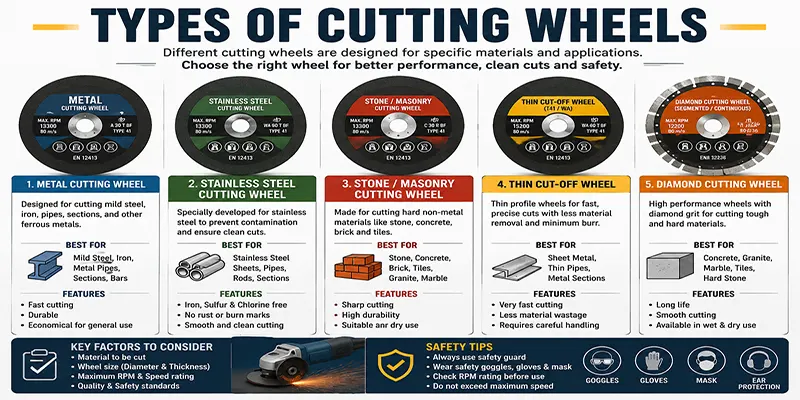
Cutting Wheel Buying Guide: Types of Cutting Wheels
Metal Cutting Wheel
Metal cutting wheels are the most commonly used abrasive wheels and are designed for cutting mild steel, iron, steel rods, pipes, and structural sections.
Best For
- Mild Steel
- Steel Pipes
- Steel Rods
- Fabrication Work
- Construction Sites
Advantages
- Fast cutting
- Clean finish
- Affordable
- Easy to find
Limitations
- Not suitable for concrete or tiles.
Stainless Steel (INOX) Cutting Wheel
INOX cutting wheels are specially designed for cutting stainless steel without contaminating the material. They are commonly used in fabrication workshops, food processing equipment manufacturing, and industrial applications.
Best For
- Stainless Steel Sheets
- Stainless Steel Pipes
- Kitchen Equipment
- Industrial Fabrication
Advantages
- Cleaner cuts
- Reduced contamination
- Better finish
Diamond Cutting Wheel
Diamond cutting wheels contain industrial diamond particles that provide excellent performance when cutting hard materials.
Best For
- Concrete
- Granite
- Marble
- Stone
- Ceramic Tiles
Advantages
- Long service life
- Precise cutting
- Excellent durability
Limitations
- More expensive than abrasive wheels.
Masonry Cutting Wheel
Masonry cutting wheels are designed for cutting bricks, cement blocks, concrete products, and paving materials.
Best For
- Bricks
- Cement Blocks
- Concrete Products
- Masonry Work
Advantages
- Suitable for construction work
- Good cutting speed
- Cost-effective
Multi-Purpose Cutting Wheel
Multi-purpose cutting wheels are designed to handle a variety of materials, making them useful for maintenance work and general-purpose applications.
Best For
- Mixed materials
- Maintenance work
- Repair jobs
Advantages
- Versatile
- Convenient
- Reduces the need for multiple wheels
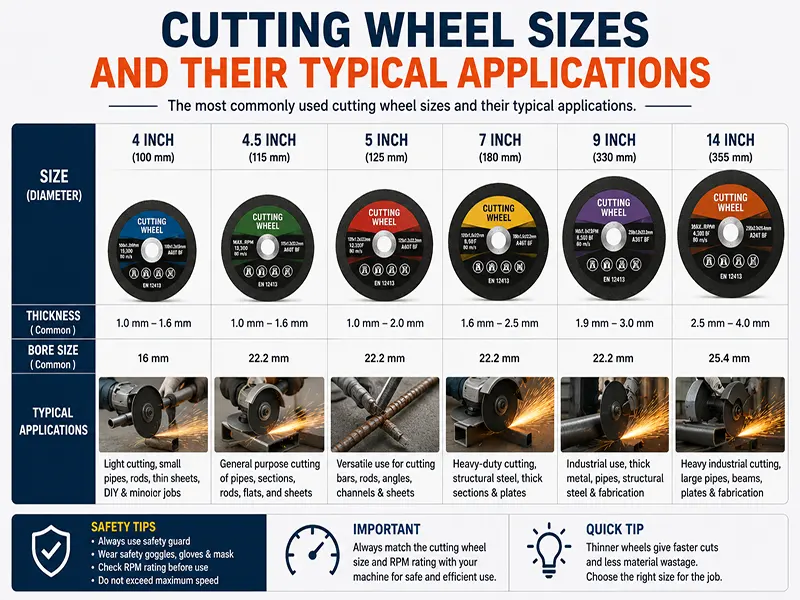
Cutting Wheel Buying Guide: Common Cutting Wheel Sizes
Choosing the correct cutting wheel size is just as important as selecting the right type. Using the wrong size can reduce cutting efficiency, affect safety, and even damage your power tool.
Below are the most commonly used cutting wheel sizes and their typical applications.
| Cutting Wheel Size | Common Applications | Compatible Tools |
|---|---|---|
| 4 Inch (100 mm) | Light fabrication, home repairs | Small Angle Grinder |
| 4.5 Inch (115 mm) | General workshop work | Angle Grinder |
| 5 Inch (125 mm) | Medium-duty cutting | Angle Grinder |
| 7 Inch (180 mm) | Heavy fabrication | Large Angle Grinder |
| 9 Inch (230 mm) | Structural steel cutting | Heavy-duty Angle Grinder |
| 14 Inch (355 mm) | Industrial cutting | Cut-Off Machine |
Buying Tip: Always use the wheel size recommended by your machine manufacturer. Never force a larger wheel onto a smaller grinder.
Cutting Wheel Buying Guide: How to Choose the Right Cutting Wheel
Before buying a cutting wheel, consider these important factors.
1. Material You Need to Cut
Different cutting wheels are designed for different materials.
| Material | Recommended Wheel |
|---|---|
| Mild Steel | Metal Cutting Wheel |
| Stainless Steel | INOX Cutting Wheel |
| Concrete | Diamond Cutting Wheel |
| Granite | Diamond Cutting Wheel |
| Marble | Diamond Cutting Wheel |
| Bricks | Masonry Cutting Wheel |
| Ceramic Tiles | Diamond Tile Blade |
2. Wheel Diameter
Choose a wheel that matches your grinder or cut-off machine.
Using the correct diameter ensures better performance and safer operation.
3. Wheel Thickness
Thin cutting wheels generally provide:
- Faster cutting
- Cleaner finish
- Less material loss
Thicker wheels are often chosen when durability is more important than cutting speed.
4. Maximum RPM Rating
Always check the wheel’s maximum RPM.
The wheel’s rated speed should be equal to or higher than your machine’s operating speed.
Ignoring this can be dangerous.
5. Product Quality
A high-quality cutting wheel usually provides:
- Better cutting performance
- Longer service life
- Reduced vibration
- Improved operator safety
Choosing a reliable product often results in better overall value than selecting the cheapest option.
Red vs Green Cutting Wheels: What’s the Difference?
If you’ve seen both red and green cutting wheels, you may wonder whether the colour indicates what material the wheel is designed to cut. In many abrasive products, colour can be associated with the abrasive material or intended application. However, colour coding varies between manufacturers, so always check the markings and specifications printed on the wheel before use.
Red Cutting Wheels
Red or reddish-brown abrasive wheels are commonly associated with aluminium oxide abrasives, which are widely used for cutting ferrous metals such as mild steel and iron.
Common applications include:
- Cutting mild steel pipes and rods.
- Cutting iron and steel sections.
- Fabrication and general metalwork.
- Construction and repair work.
Green Cutting Wheels
Manufacturers commonly make green abrasive wheels with silicon carbide abrasives. Silicon carbide is particularly suitable for certain hard, brittle, and non-ferrous materials, although the exact application depends on the wheel’s design and manufacturer specifications.
Common applications can include:
- Cutting certain non-ferrous metals.
- Cutting stone and masonry materials.
- Applications where silicon carbide abrasives are specified.
- Specialised cutting and grinding work.
Red vs Green Cutting Wheel Comparison
| Feature | Red Cutting Wheel | Green Cutting Wheel |
|---|---|---|
| Common abrasive association | Aluminium oxide | Silicon carbide |
| Common applications | Mild steel, iron and ferrous metals | Certain non-ferrous, masonry and other specialised applications |
| Typical use | General metal fabrication | Material-specific applications |
| Best choice depends on | Material being cut and wheel specification | Material being cut and wheel specification |
Which One Should You Buy?
Don’t choose a cutting wheel only by its colour.
Instead, check:
- The material you want to cut.
- The abrasive type specified by the manufacturer.
- The wheel’s intended application.
- The maximum RPM rating.
- The machine and wheel size compatibility.
For example, if you’re cutting mild steel, choose a wheel specifically labelled for steel or ferrous metals rather than assuming that every red wheel is suitable. Likewise, don’t assume that every green wheel is suitable for masonry or non-ferrous materials.
Buying Tip: The colour can provide a useful visual clue, but the manufacturer’s markings and application specifications should always be your final guide.
Cutting Wheel Buying Guide: Common Buying Mistakes
Avoid these mistakes when purchasing or using a cutting wheel.
❌ Buying only based on price
A cheaper wheel may wear out faster and require more frequent replacement.
❌ Using one wheel for every material
Metal, concrete, tiles, and stainless steel require different cutting wheels.
Using the wrong wheel reduces cutting performance and may damage the wheel.
❌ Ignoring the RPM Rating
Every cutting wheel has a maximum operating speed.
Always ensure the wheel is compatible with your machine.
❌ Using a damaged wheel
Never use wheels that are cracked, chipped, or damaged.
Replace damaged wheels immediately.
❌ Choosing the wrong wheel size
Using an incorrect wheel size can reduce cutting accuracy and create unnecessary safety risks.
Cutting Wheel Buying Guide: Safety Tips
Working with cutting wheels requires proper safety precautions.
Follow these best practices every time you use a cutting wheel.
- Wear safety goggles.
Wear protective gloves.
- Use hearing protection when required.
- Inspect the wheel before installation.
- Secure the workpiece before cutting.
- Allow the machine to reach full speed before beginning the cut.
- Never force the wheel through the material.
- Store cutting wheels in a dry location.
- Replace damaged wheels immediately.
Safety should always take priority over speed.
Cutting Wheel Buying Guide: Frequently Asked Questions
What is a cutting wheel used for?
A cutting wheel is used to cut materials such as steel, stainless steel, concrete, tiles, bricks, stone, and other construction materials using power tools like angle grinders and cut-off machines.
Which cutting wheel is best for metal?
Metal cutting wheels are specifically designed for cutting mild steel, iron, pipes, rods, and structural steel.
Can I use a metal cutting wheel on concrete?
No.
Metal cutting wheels are not designed for cutting concrete or masonry materials. For concrete, a diamond cutting wheel is generally the better choice.
Which cutting wheel is best for stainless steel?
An INOX cutting wheel is recommended because it is designed to cut stainless steel while helping maintain a clean finish.
How do I choose the correct cutting wheel size?
Choose the size recommended by your angle grinder or cut-off machine. Common sizes include 4″, 4.5″, 5″, 7″, 9″, and 14″.
How long does a cutting wheel last?
The lifespan depends on the material being cut, wheel quality, operating speed, and proper usage. Using the correct wheel for the intended application helps maximise its service life.
Can cutting wheels expire?
Yes. Abrasive cutting wheels have a shelf life, so always check the manufacturer’s information and inspect the wheel before use.
Is a diamond cutting wheel better than an abrasive cutting wheel?
Neither is universally better. Diamond cutting wheels are generally preferred for concrete, stone, and tiles, while abrasive cutting wheels are commonly used for metal and steel.
Cutting Wheel Standards and Safety Organizations
Cutting wheels are covered by standards and safety guidance that help manufacturers and users maintain consistent requirements for product dimensions, markings, and safe operation.
A few organisations worth knowing are:
- ISO (International Organization for Standardization) – Publishes international standards, including standards covering cutting-off wheel dimensions and specifications. Visit ISO
- BIS (Bureau of Indian Standards) – India’s national standards body, which publishes Indian Standards for various products, including abrasive products. Visit BIS
- FEPA (Federation of European Producers of Abrasives) – Provides technical and safety guidance for abrasive products, including cutting and grinding wheels. Visit FEPA
- ANSI (American National Standards Institute) – Coordinates voluntary consensus standards in the United States, including safety standards relating to abrasive wheels. Visit ANSI
What to Check Before Using a Cutting Wheel
Always check the wheel for its size, thickness, bore, maximum RPM, intended application, manufacturer information, and safety markings before use.
Cutting Wheel Buying Guide: Final Thoughts
Choosing the right cutting wheel is about more than selecting the correct size. The material being cut, wheel type, thickness, machine compatibility, and safety requirements all play an important role in achieving efficient and accurate results.
A quality cutting wheel can improve cutting speed, produce cleaner finishes, reduce material wastage, and enhance operator safety. Before purchasing, identify the material you’ll be working with and select a cutting wheel designed specifically for that application.
Whether you’re a contractor, fabricator, workshop owner, engineer, or DIY enthusiast, investing in the right cutting wheel can improve productivity and deliver better results on every project.
🛒 Shop Cutting Wheels Online
Ready to choose the right cutting wheel for your next project?
Browse our range of cutting wheels suitable for metal fabrication, stainless steel, construction, masonry, and general industrial applications. Whether you’re buying a single piece or placing a bulk order, WholesaleHardware.in offers quality products at competitive prices.
👉 Browse Cutting Wheels:
Cutting Tools
Need help selecting the right cutting wheel? Contact our team, and we’ll be happy to recommend the best option based on your application and material.
🔧 Explore More Hardware Categories
Looking for quality hardware products? Explore our popular product categories:
Browse our complete range of hardware products at WholesaleHardware.in for residential, commercial, industrial, and construction projects.
🔍 You May Also Like
If you found this guide useful, you may also be interested in these articles:
- 🔨 Hammer Buying Guide – Understand different hammer types and how to choose the right one.
- 🔩 Binding Wire Buying Guide – Learn about wire gauges, applications, and buying tips.
- ⚙️ Different Types of Fasteners and Their Uses (Coming Soon)
- 🛠️ Construction Tools List (Coming Soon)
- 🪛 Types of Screwdrivers and Their Uses (Coming Soon)
- 📏 Angle Grinder Buying Guide (Coming Soon)
These guides are written to help contractors, builders, engineers, hardware dealers, fabricators, and DIY enthusiasts make informed purchasing decisions.
📞 Need Help Choosing the Right Cutting Wheel?
Not sure which cutting wheel is best for your project?
Whether you’re cutting mild steel, stainless steel, concrete, tiles, or masonry, choosing the right wheel can improve safety, efficiency, and cutting performance.
Our team can help you select the right hardware products for fabrication workshops, construction sites, industrial projects, maintenance work, and bulk wholesale requirements.
📞 Contact Our Experts
📱 Call / WhatsApp: +91 9951836524
🌐 Website: https://wholesalehardware.in
📩 Contact Us: https://wholesalehardware.in/contact-us/
📢 WhatsApp Channel: https://whatsapp.com/channel/0029Vb7kFcPGzzKK5wfKhf0Q
📘 Facebook: https://www.facebook.com/wholesalehardware.in/
📷 Instagram: https://www.instagram.com/wholesalehardware.in/
⭐ Why Choose WholesaleHardware.in?
- Wide Range of Hardware Products
- Trusted Brands
- Competitive Wholesale Pricing
- Bulk Orders Welcome
- Fast Delivery Across India
- Expert Product Guidance
- Dedicated Customer Support
Reliable Information Through Expert Buying Guides
Whether you’re a contractor, builder, engineer, workshop owner, hardware retailer, fabricator, or DIY enthusiast, WholesaleHardware.in is committed to providing quality hardware products, practical buying advice, and dependable customer support.

Thông tin hữu ích quá. Letco tự hào là công ty tư vấn du học Hàn Quốc uy tín, cam kết đồng hành đến khi bạn nhập học thành công. Xem thêm tại letco.vn.
Another important reason to modify to solar power could be the financial savings it provides. Solar energy panels are designed for generating electricity for businesses, reducing or eliminating the necessity for traditional types of energy. This may bring about significant savings on energy bills, particularly in areas with a high energy costs. Furthermore, there are many different government incentives and tax credits open to companies that adopt solar technology, which makes it a lot more cost-effective and affordable.
The technology behind solar technology is not at all hard, yet highly effective. Solar energy panels are made up of photovoltaic (PV) cells, which convert sunlight into electricity. This electricity may then be stored in batteries or fed directly into the electrical grid, according to the specific system design. To be able to maximize the many benefits of solar power, you should design a custom system this is certainly tailored to your particular energy needs and requirements. This may make certain you have the proper components in position, like the appropriate wide range of solar power panels additionally the right style of batteries, to optimize your power efficiency and value savings.
[url=https://www.acoredu.com/forums/topic/how-to-make-new-friends/]Understanding solar plantations located in MA by Matthew dagati.[/url]
[url=http://forum.timelinewatch.com/viewtopic.php?p=331#p331]Productivity Metrics among Photovoltaic Forces Collection[/url] 64dbbb0
Recommended reading for today click here
From a good few months I have been interested in gaming tournaments, and along the way I decided to explore the topic of placing bets on esports in an internet casino, as opposed to standard sites dedicated to esports. A lot of friends kept saying that betting on esports only makes sense solely with dedicated bookmakers, for that reason I wanted to test it personally on [url=https://pocketadmin.tech/]Rolling Slots[/url], because there I found a section focused on tournament predictions, containing matches of professional teams from all over the world. Initial experiences came out really good, since the list of available bets on tournaments was much wider, compared to what I assumed. Besides classic final result prediction, to choose from appeared bets on the number of maps, and also bets on the first map winner, which opened significantly a greater choice variants selected to my own knowledge of the teams. Especially I paid attention to history of direct confrontations, since player popularity rarely by itself mean a good prediction. After a series of observations I became convinced that a significant influence possesses the current team form, and which map the match is played on. To everyone who like me wants to know in what place I started, I usually send https://pocketadmin.tech/, since it turns out easier to convince yourself personally, than describing everything from scratch. Before I started betting larger bets, I devoted quite a lot of time in order to analyze tournament statistics, because betting without knowledge of the game not very often bring sensible outcomes in the long run. I quickly realized that the basis to sensible betting is sticking to set limits, and not placing risky amounts on a single map. In connection with this I set myself a fixed amount for the next bet, regardless of confidence towards a specific prediction.
The other day, my friends and I got together to enjoy a cozy hangout after the work week and catch up. We all love a good thrill, so at some point, we decided to give our luck a spin and headed over to the [url=https://portatilesbaratos.tech/] Rolling Slots Casino[/url]. The vibe got us hooked fast, so time passed in the blink of an eye. A couple of us landed some epic multipliers, while others left a small amount behind, but in the end, the excitement was off the charts.
At https://portatilesbaratos.tech/, the game selection is huge. Along the way, we had plenty of laughs and cheered each other on during every spin, watching the bonus rounds play out. Your balance goes up and down, but a great night out with good friends like this will be remembered for a long time to come.
So I’ve been going down the rabbit hole of luxury advisor guides lately, trying to figure out if hiring someone to curate high-end purchases is actually worth the money or just a fancy markup. Some of these guides read like they were written by people who’ve never actually bought anything expensive, honestly. Others genuinely break down how these advisors source rare items and negotiate deals you’d never get on your own. Still trying to separate the useful ones from the fluff.
Has anyone actually hired a luxury advisor after reading through one of these guides, or is it mostly theoretical for most of us? I keep seeing claims about exclusive access and personalized service, sounds great on paper. But I’d rather hear from someone who’s actually paid for it and felt it was worth every penny. Thoughts?
Honestly I stumbled onto this site while trying to figure out which watch was actually worth the hype, and I ended up spending way more time than planned reading through the breakdowns. It’s not flashy, just seems like people who actually know the market putting things in plain terms. Anyone else find themselves going down a rabbit hole with stuff like this?
At this point I’ve bookmarked it because I keep going back whenever I’m tempted to splurge on something I don’t fully understand yet. It’s not perfect, some sections feel a bit thin, but overall it’s saved me from a couple of impulsive mistakes. Do you guys have a go-to resource before making bigger purchases too?
luxuryadvisorguide.com [url=https://www.luxuryadvisorguide.com#luxuryadvisorguide.com]https://www.luxuryadvisorguide.com[/url] .