Safety equipment is essential for construction workers who face hazards such as falling objects, flying particles, sharp materials, moving vehicles, loud machinery and dust. The right personal protective equipment (PPE) can help reduce a worker’s exposure to many of these hazards.
While the exact PPE required depends on the work being performed and the risks involved, some types of safety equipment are commonly found across construction sites.
In this guide, we’ll look at six must-have categories of construction safety equipment, with a closer look at safety helmets, reflective jackets, goggles, gloves and safety footwear.
What Is Personal Protective Equipment?
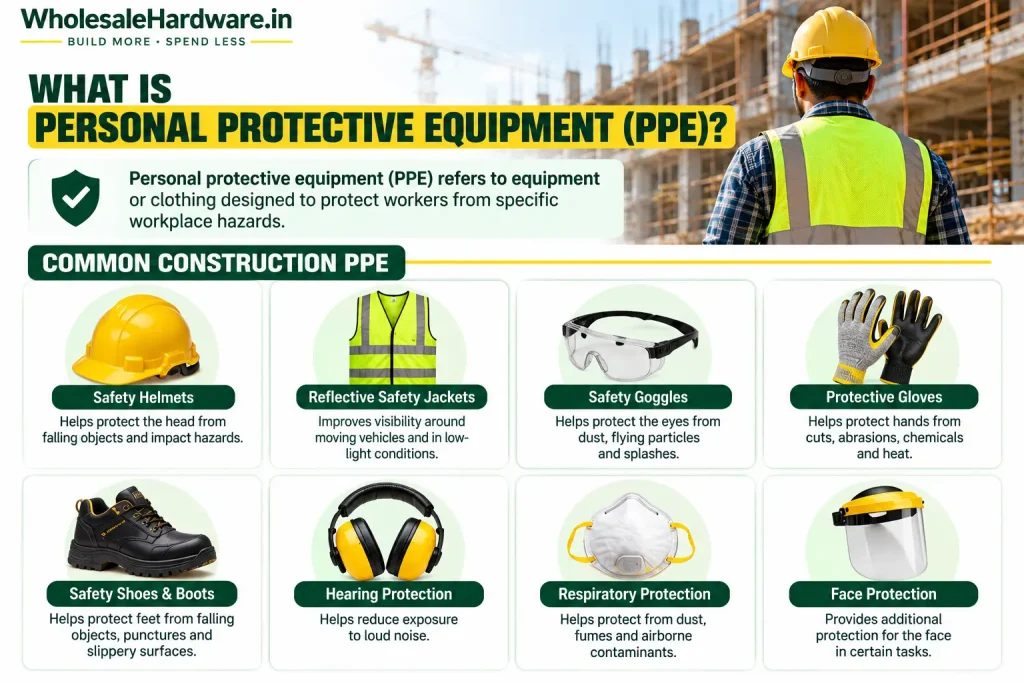
Personal protective equipment, commonly known as PPE, refers to equipment or clothing designed to protect workers from specific workplace hazards.
Common construction PPE includes:
- Safety helmets
- Reflective safety jackets
- Safety goggles
- Protective gloves
- Safety shoes and boots
- Hearing protection
- Respiratory protection
- Face shields and other specialised equipment
PPE is an important part of workplace safety, but it should work alongside safe operating procedures, training, hazard controls and proper supervision.
1. Safety Helmet or Hard Hat
A safety helmet is one of the most important pieces of PPE on a construction site. It is designed to help protect the head from hazards such as falling or flying objects and certain types of impact.
Construction workers may spend their time beneath scaffolding, around building materials, near lifting operations or alongside other workers working at height. In these environments, appropriate head protection can be essential.
Why Is a Safety Helmet Important?
A suitable industrial safety helmet can help protect the head from relevant impact hazards.
Depending on the product and its rating, helmets may also provide protection against additional hazards. This is why it is important to select a helmet according to the requirements of the job rather than simply choosing one based on appearance.
In India, IS 2925 covers industrial safety helmets. BIS testing information for the standard includes requirements relating to areas such as shock absorption, penetration resistance, flammability, electrical resistance, water absorption and heat resistance.
What Are the Main Parts of a Safety Helmet?
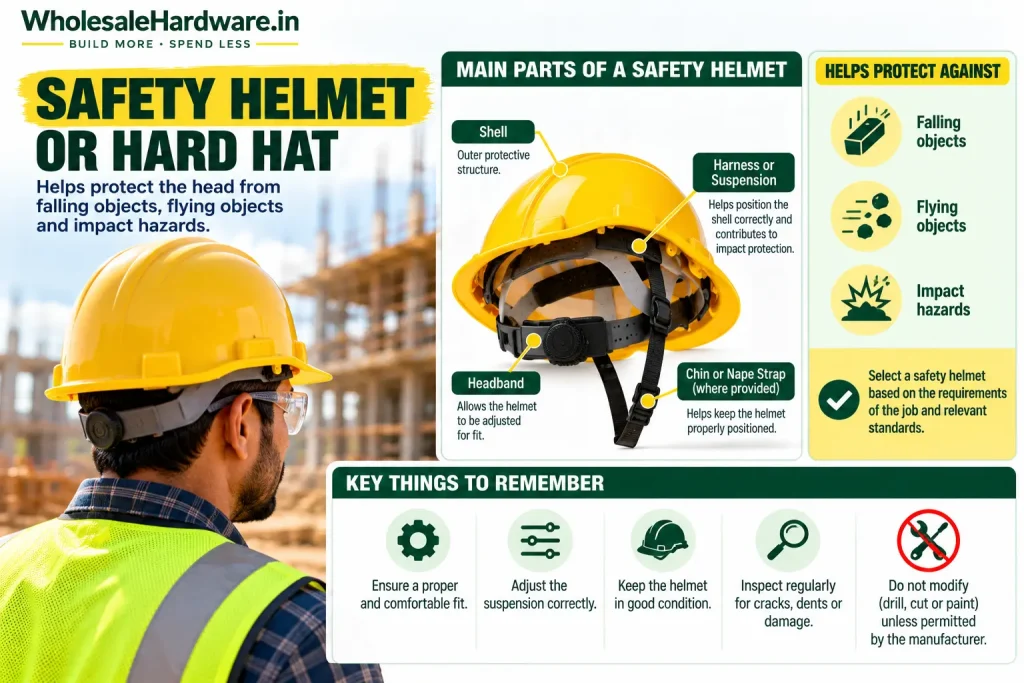
A typical safety helmet consists of:
- Shell — the outer protective structure.
- Harness or suspension — helps position the shell correctly on the head and contributes to impact protection.
- Headband — allows the helmet to be adjusted for fit.
- Chin or nape strap, where provided — helps keep the helmet properly positioned.
The helmet and its suspension work together, so both should be kept in good condition.
How Should a Safety Helmet Fit?
A helmet should sit securely and comfortably on the worker’s head.
Check that:
- The suspension is adjusted correctly.
- The helmet does not move excessively during normal movement.
- The shell sits in the position specified by the manufacturer.
- Any supplied straps are used correctly.
- The helmet does not interfere unnecessarily with other PPE.
Inspect Your Helmet Regularly
Before use, check for:
- Cracks
- Dents
- Deformation
- Damaged suspension
- Loose components
- Signs of deterioration
- Other visible damage
A helmet that has experienced a significant impact should be assessed according to the manufacturer’s instructions and replaced when required.
Avoid drilling, cutting, painting or otherwise modifying a safety helmet unless the manufacturer specifically permits it.
2. Reflective Safety Jacket
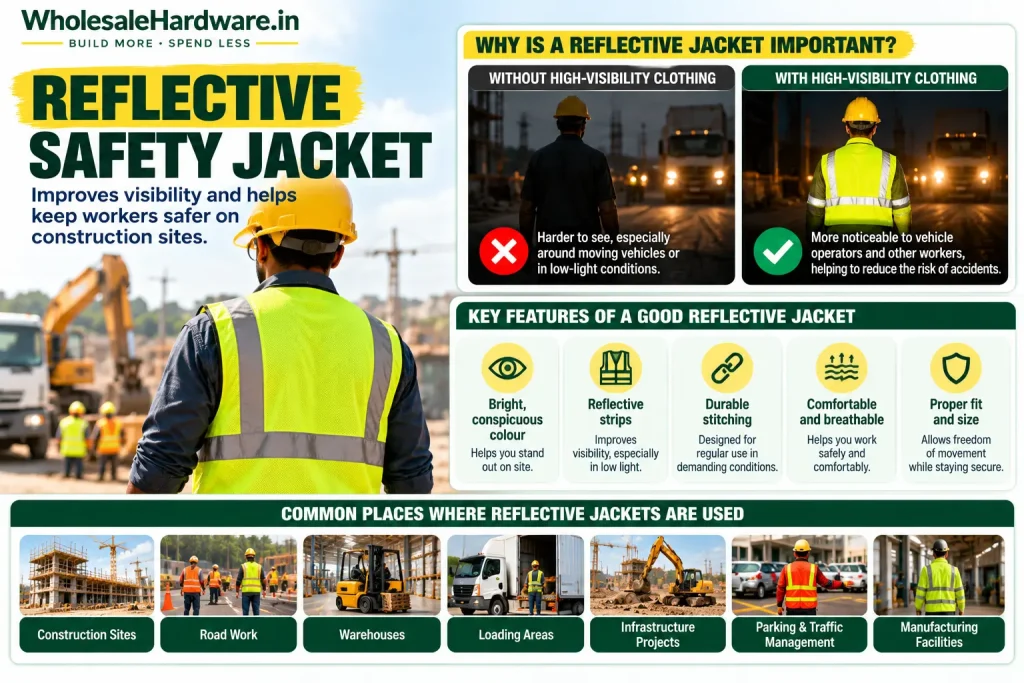
A reflective safety jacket, also known as a high-visibility vest or safety vest, is designed to make workers more noticeable to vehicle operators and other people working around them.
This can be particularly important on construction sites where workers share space with:
- Trucks
- Excavators
- Cranes
- Forklifts
- Loaders
- Other mobile equipment
- Road traffic
Why Is a Reflective Jacket Important?
A worker may be wearing a helmet and safety footwear but still be difficult to see from a distance.
High-visibility clothing uses conspicuous colours and reflective materials to help draw attention to the wearer.
This becomes particularly useful when workers are operating around moving vehicles or in conditions where visibility is reduced.
Where Are Reflective Jackets Used?
High-visibility jackets can be useful in:
- Construction sites
- Road work
- Warehouses
- Loading areas
- Manufacturing facilities
- Parking and traffic-management areas
- Infrastructure projects
- Areas with heavy vehicle movement
They can be especially useful during early morning, evening or other low-visibility working conditions.
What Should You Look for in a Reflective Safety Jacket?
When selecting one, consider:
- Visibility of the base colour
- Reflective-strip placement
- Quality of reflective material
- Stitching and construction
- Size and fit
- Freedom of movement
- Breathability
- Durability
- Applicable standards
A jacket should be comfortable enough for workers to wear throughout their working period.
Reflective Material Matters
The reflective portions of the jacket are not simply decorative. Their purpose is to make the wearer more noticeable when illuminated, such as by vehicle headlights.
ISO 20471:2013 specifies requirements for high-visibility clothing, including requirements related to colour, retroreflection, minimum areas and placement of high-visibility materials. ISO currently has a new edition under development.
This means buyers should check the actual product specification when a particular high-visibility standard is required for a project.
Take Care of High-Visibility Clothing
Keep reflective jackets in usable condition.
Check for:
- Torn fabric
- Damaged reflective strips
- Heavy soiling
- Loose stitching
- Fading
- Other damage that could affect visibility
Follow the manufacturer’s cleaning and care instructions because improper cleaning can affect some reflective materials.
3. Safety Goggles and Eye Protection
Our eyes can be exposed to flying particles, dust, splashes and other hazards during construction, fabrication and maintenance work.
Safety goggles and protective eyewear help provide protection appropriate to the hazards of the task.
What Can Safety Goggles Protect Against?
Depending on their design and rating, protective eyewear can be intended for hazards such as:
- Flying particles
- Dust
- Wood chips
- Metal particles
- Liquid splashes
- Chemical splashes
- Other task-specific hazards
The correct eyewear depends on what the worker is actually exposed to.
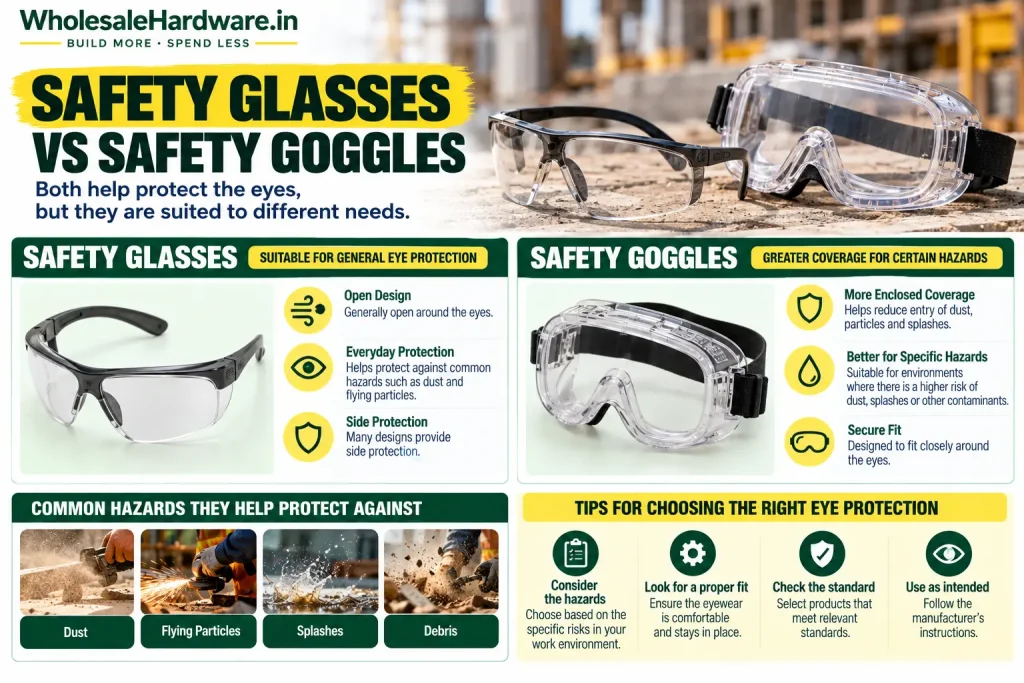
Safety Glasses vs Safety Goggles
Glasses and safety goggles aren’t necessarily interchangeable.
Safety glasses generally provide eye protection while leaving some ventilation around the eye area.
Safety goggles generally provide greater coverage around the eyes and can be useful where dust, splashes or other hazards require more enclosed protection.
The choice should be based on the hazard rather than simply personal preference.
What Should You Look for in Safety Goggles?
Consider:
- Appropriate impact protection
- Lens material
- Optical quality
- Side protection
- Fit
- Ventilation
- Anti-fog features where appropriate
- Compatibility with other PPE
- Applicable markings and standards
A good fit is particularly important. If goggles are uncomfortable or constantly slip, workers may be tempted to remove them during work.
Eye Protection Standards in India
BIS lists IS 8521 (Part 1):2022 for general requirements for occupational eye and face protection, along with additional parts covering specific types of protection. BIS also lists IS 8520:2023 as guidance on the selection, use and maintenance of eye and face protection.
When purchasing safety eyewear for a specific project, check the product’s markings and documentation against the required specification.
4. Safety Gloves
Hands are involved in almost every construction activity, which makes safety gloves one of the most widely used categories of PPE.
The correct gloves can help protect against hazards such as abrasion, cuts, rough surfaces, chemicals, heat and other task-specific risks.
Why Are Safety Gloves Important?
Construction workers may handle:
- Bricks
- Metal
- Wood
- Cement products
- Tools
- Pipes
- Sharp materials
- Rough surfaces
- Chemicals and adhesives
Different tasks create different hazards, so choosing the right glove matters.
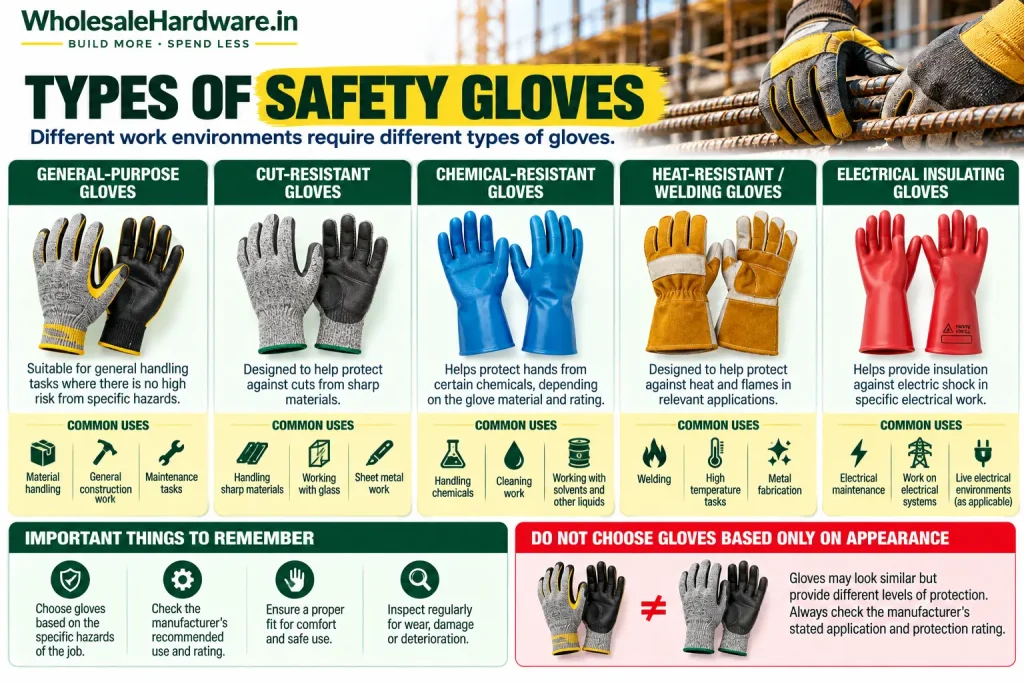
Different Types of Safety Gloves
General-Purpose Work Gloves
These are intended for routine handling and can provide protection against minor abrasion and general handling hazards.
Cut-Resistant Gloves
Designed for work involving sharp edges or cutting hazards.
They can be particularly useful when handling sheet metal, sharp components or other materials with cutting risks.
Chemical-Resistant Gloves
Used when workers handle chemicals or substances that require specific chemical protection.
The glove material must be suitable for the particular chemical involved.
Heat-Resistant and Welding Gloves
Designed for applications involving heat, sparks and certain thermal hazards.
Electrical Insulating Gloves
These are specialised products intended for electrical work and should be selected according to the applicable electrical safety requirements.
How Should Safety Gloves Fit?
A good safety glove should be:
- The correct size
- Secure
- Comfortable
- Suitable for the required hand movements
- Appropriate for the task
A glove that is too loose can interfere with handling, while one that is too tight can restrict movement and become uncomfortable.
Don’t Choose Gloves Based Only on Appearance
Two gloves can look very similar while offering very different protection.
For example, a general-purpose work glove should not automatically be assumed to provide cut, chemical, heat or electrical protection.
Always check the manufacturer’s stated application and protection rating.
Protective Glove Standards
ISO 21420:2020 specifies general requirements and test methods for protective glove design, construction, comfort, efficiency, marking and information supplied by the manufacturer. It does not by itself define the protective properties for every hazard; additional specific standards may apply.
5. Safety Shoes and Boots
Construction workers spend much of their working day on their feet and may encounter falling objects, sharp materials, slippery surfaces, uneven ground and other hazards.
Safety footwear is designed to provide protection against specific workplace risks.
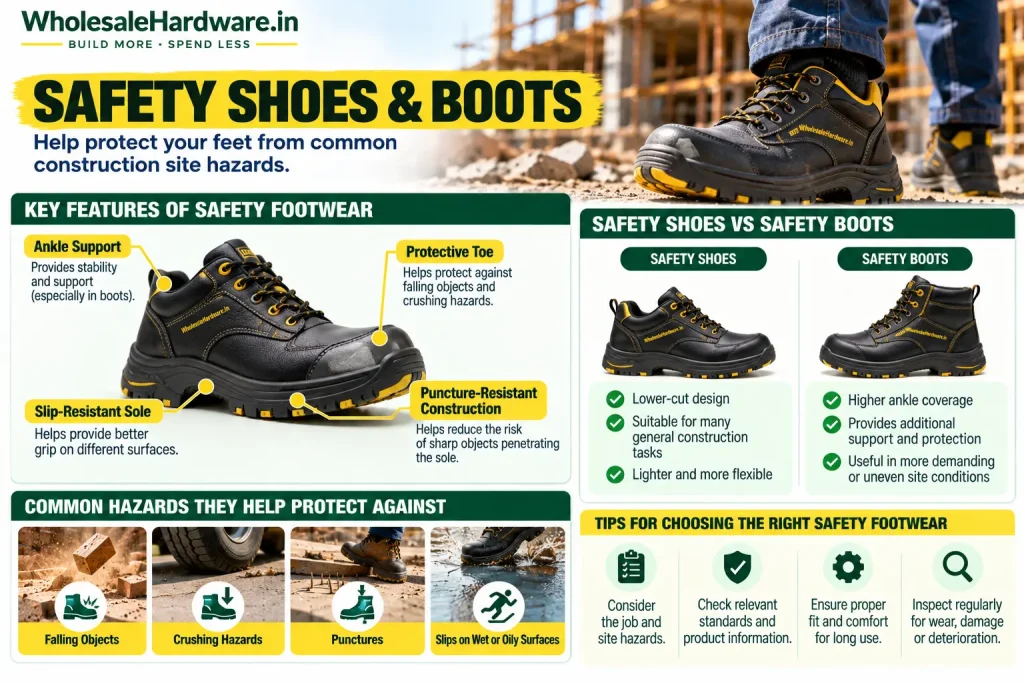
Why Are Safety Shoes Important?
Depending on their design and rating, safety footwear can help protect against hazards such as:
- Falling objects
- Crushing
- Slipping
- Punctures
- Certain environmental conditions
- Other job-specific risks
What Should You Look for in Safety Footwear?
Consider:
- Protective toe protection where required
- Slip resistance
- Sole construction
- Puncture resistance where required
- Fit
- Comfort
- Ankle coverage
- Resistance to relevant substances
- Applicable standards
Don’t choose footwear simply because it looks heavy-duty. The protective features need to match the actual work environment.
Safety Shoes vs Safety Boots
Shoes can be suitable for many construction and industrial environments where lower-cut footwear provides sufficient protection.
Safety boots provide greater coverage around the ankle and can be useful where the work environment or site requirements call for additional coverage.
The right choice depends on the job.
Safety Footwear Standards
BIS lists IS 15298 for personal protective equipment footwear, including safety, protective and occupational footwear. Current BIS records include IS 15298 Part 2:2024, aligned with ISO 20345:2021 with modifications.
Internationally, ISO 20345:2021 specifies basic and additional requirements for safety footwear, including areas such as mechanical risks, slip resistance, thermal risks and ergonomic behaviour.
Fit Matters
Even good safety footwear can become difficult to use if it doesn’t fit correctly.
Check:
- Length
- Width
- Toe-room
- Heel fit
- Comfort during movement
- Compatibility with the socks normally worn at work
6. Hearing and Respiratory Protection
The first five categories are among the most visible forms of construction PPE, but some hazards affect workers in less obvious ways.
Two important examples are excessive noise and airborne contaminants.
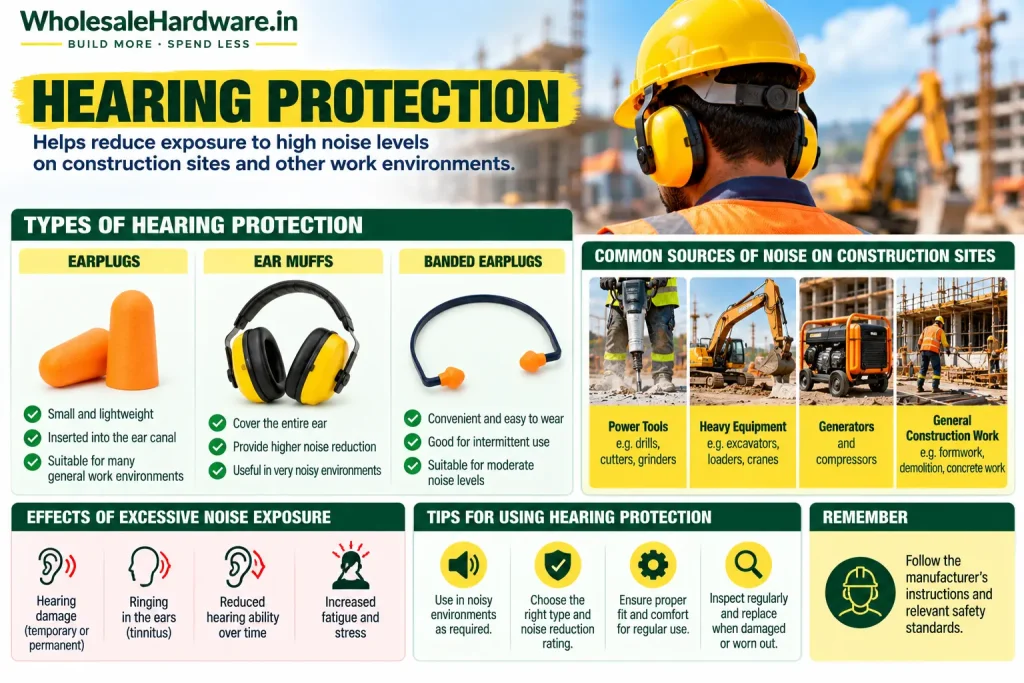
Hearing Protection
Construction equipment such as grinders, drills, pneumatic tools and other machinery can generate significant noise.
Depending on the exposure and workplace requirements, hearing protection may include:
- Earplugs
- Ear muffs
- Other suitable hearing protectors
The correct protection should be selected according to the noise hazard and the manufacturer’s information.
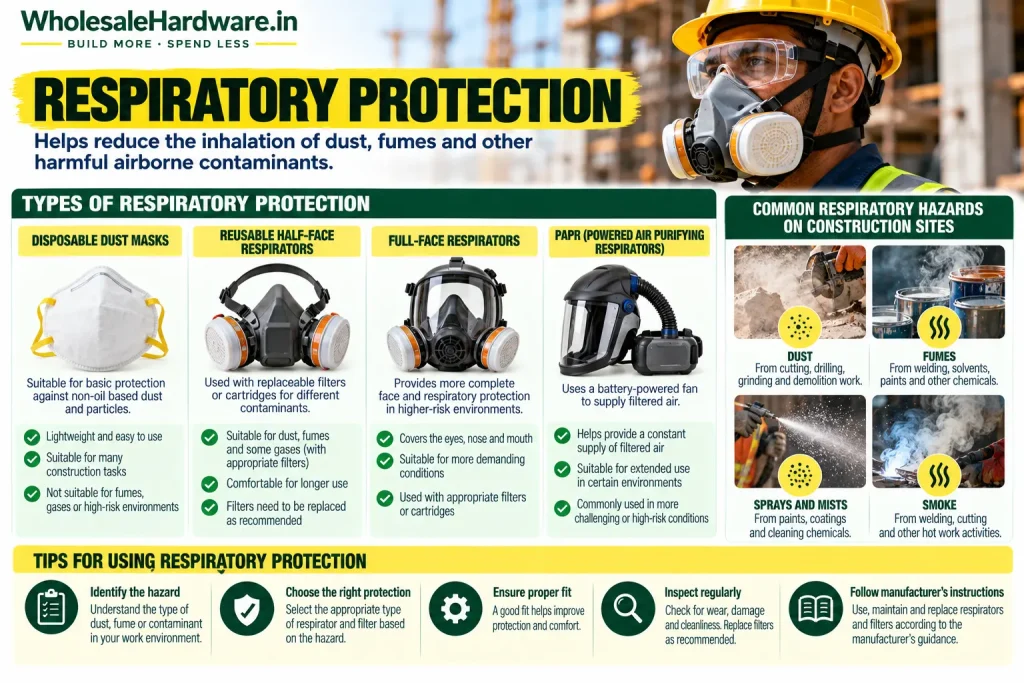
Respiratory Protection
Construction and maintenance work can also create dust, fumes, mists and other airborne contaminants.
Depending on the hazard, workers may require suitable respiratory protection.
The correct respirator depends on the contaminant and exposure. A basic dust mask should not automatically be treated as protection against gases, vapours or other chemical hazards.
For specialised respiratory hazards, appropriate selection, fit and workplace procedures are important.
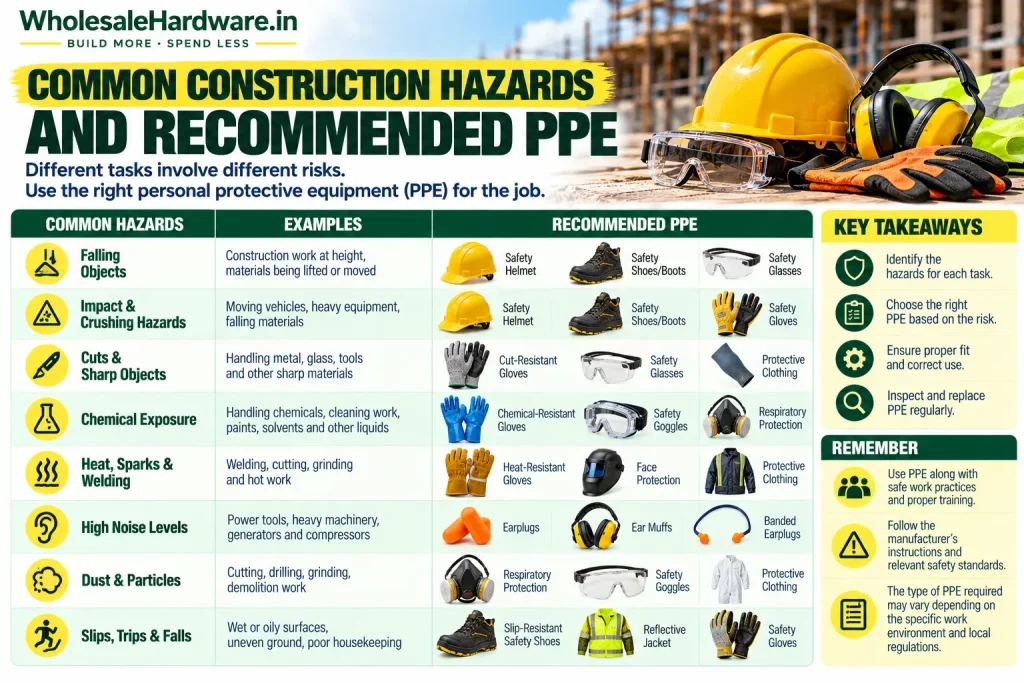
Why PPE Should Match the Job
There is no single piece of PPE that protects a worker against every construction hazard.
For example:
- A safety helmet addresses head hazards.
- A reflective jacket improves worker visibility.
- Safety goggles protect the eyes against relevant hazards.
- Gloves protect the hands according to their specific design.
- Safety footwear provides protection against relevant foot hazards.
- Hearing and respiratory protection address specific exposure risks.
This is why PPE selection should begin with identifying the hazards associated with the work.
Common Construction PPE Mistakes
Even good protective equipment can become less effective when it is used incorrectly.
Avoid these common mistakes:
- Wearing a helmet without adjusting it properly.
- Continuing to use visibly damaged PPE.
- Choosing gloves without considering the actual hazard.
- Using ordinary glasses where suitable safety eyewear is required.
- Choosing safety footwear based only on appearance.
- Wearing a damaged or heavily soiled reflective jacket.
- Using the wrong type of respiratory protection.
- Assuming one type of PPE protects against every hazard.
- Modifying protective equipment without manufacturer approval.
- Ignoring the manufacturer’s instructions.
Safety Equipment Standards and Organisations
Safety equipment can be manufactured and tested according to different national and international standards. The applicable requirements depend on the type of PPE and the intended application.
Bureau of Indian Standards — BIS
The Bureau of Indian Standards (BIS) is India’s national standards body. Relevant Indian Standards include IS 2925 for industrial safety helmets, IS 8521 for occupational eye and face protection and IS 15298 for safety footwear.
Bureau of Indian Standards (BIS)
DGFASLI
The Directorate General Factory Advice Service & Labour Institutes (DGFASLI) operates under India’s Ministry of Labour & Employment and has facilities involved in PPE testing. Its documentation states that PPE is tested against specifications set by BIS.
DGFASLI – Ministry of Labour & Employment
ISO
The International Organization for Standardization (ISO) publishes international standards relevant to PPE, including standards covering high-visibility clothing, protective gloves and safety footwear.
International Organization for Standardization (ISO)
Important: The presence of a standard number does not automatically mean that every product in that category complies with that standard. When compliance is important, check the product’s markings, manufacturer documentation and applicable requirements.
How to Choose the Right Safety Equipment
Before buying PPE, start with the work and the hazards involved.
1. Identify the Work
Consider what the worker will actually be doing.
2. Identify the Hazards
Look for risks such as:
- Falling objects
- Flying particles
- Sharp materials
- Chemicals
- Noise
- Dust
- Moving vehicles
- Slippery surfaces
- Heat
- Electrical hazards
3. Select Suitable PPE
Choose equipment designed to address those specific hazards.
4. Check the Fit
PPE should fit the worker properly and allow the required movement.
5. Check Product Information
For projects requiring specific standards or certifications, verify the manufacturer’s markings and documentation.
6. Inspect PPE Regularly
Damaged or excessively worn equipment should be dealt with according to the manufacturer’s instructions.
Frequently Asked Questions
What are the most important safety equipment items for construction workers?
Common construction PPE includes safety helmets, reflective jackets, safety goggles, gloves and safety footwear. Depending on the job, workers may also require hearing protection, respiratory protection and other specialised equipment.
Why do construction workers wear safety helmets?
Safety helmets are designed to help protect the head against relevant hazards such as impact from falling or flying objects.
Why are reflective jackets used on construction sites?
Reflective jackets help make workers more visible, particularly around vehicles, mobile equipment and areas where visibility is reduced.
What are safety goggles used for?
Safety goggles can help protect the eyes from hazards such as flying particles, dust and splashes, depending on their design and rating.
Are all safety gloves the same?
No. Gloves are designed for different hazards and applications. General-purpose gloves should not automatically be treated as cut-resistant, chemical-resistant, heat-resistant or electrically insulating gloves.
Why are safety shoes important?
Safety footwear can help protect the feet from hazards such as impact, crushing, slipping and punctures, depending on the design and rating.
Are safety shoes and safety boots the same?
They can provide similar categories of protection, but boots generally provide greater ankle coverage. The appropriate choice depends on the job and site requirements.
What standards apply to construction PPE in India?
The applicable standard depends on the type of PPE. Examples include IS 2925 for industrial safety helmets, IS 8521 for occupational eye and face protection and IS 15298 for safety footwear.
Is PPE enough to make a construction site safe?
No. PPE is one part of a broader workplace safety system that also includes hazard identification, safe work procedures, training, engineering controls and supervision.
🛒 Looking for Construction Safety Equipment?
Looking for safety helmets, reflective jackets, safety goggles, gloves, safety shoes or other PPE for construction, industrial or general work requirements?
The right equipment depends on the type of work, the hazards involved and the protection required.
For bulk requirements, contact us with your required products, quantity and delivery location.
📚 You May Also Like
If you’re exploring construction and hardware products, you may also find these guides useful:
- Hammer Buying Guide – Understand different hammer types and their applications.
- Cutting Wheel Buying Guide – Learn about cutting wheel types, sizes and uses.
- Binding Wire Buying Guide – Understand binding wire and its construction applications.
- PP Rope Buying Guide – Understand polypropylene rope types, sizes and applications.
- Jodhpuri Plumb Bob: Uses, Types & Buying Guide – Learn how plumb bobs are used for vertical alignment. (Coming Soon!!)
- Plastic Ghamela & Gampa Buying Guide – Learn about ghamela sizes and material-handling applications.(Coming Soon!!)
🔧 Explore More Hardware Categories
Explore more hardware products for construction, workshops, fabrication, maintenance and general utility requirements.
- Construction Hardware
- Hand Tools
- Measuring Tools
- Cutting Tools
- Fasteners
- Ropes & Utility Products
- Masonry Tools
- Plumbing Hardware
- Power Tools
📞 Need Help Choosing the Right Safety Equipment?
Not sure which safety equipment is best for your construction site, workshop, industrial project or general work requirements?
Choosing the right PPE depends on the type of work being performed, the hazards involved and the level of protection required.
Whether you’re looking for safety helmets, reflective jackets, safety goggles, gloves, safety footwear or other protective equipment, our team can help you find suitable options based on your application and quantity.
📞 Contact Our Experts
📱 Call / WhatsApp: +91 99518 36524
🌐 Website: https://wholesalehardware.in
📩 Contact Us: https://wholesalehardware.in/contact-us/
📢 WhatsApp Channel: https://whatsapp.com/channel/0029Vb7kFcPGzzKK5wfKhf0Q
📘 Facebook: https://www.facebook.com/wholesalehardware.in/
📷 Instagram: https://www.instagram.com/wholesalehardware.in/
⭐ Why Choose WholesaleHardware.in?
WholesaleHardware.in provides hardware products and practical buying information for contractors, builders, fabricators, workshops, businesses, hardware dealers and general users.
Our buying guides are designed to make product selection easier by explaining applications, specifications and important factors to consider before purchasing.